
American B-2 Stealth Bombers to be Equipped with Versatile New B61-12 Nuclear Munitions Capable of Lethal Earth Penetrating Strikes; North Korea and Russia in the Crosshairs?
Military Watch Magazine Editorial Staff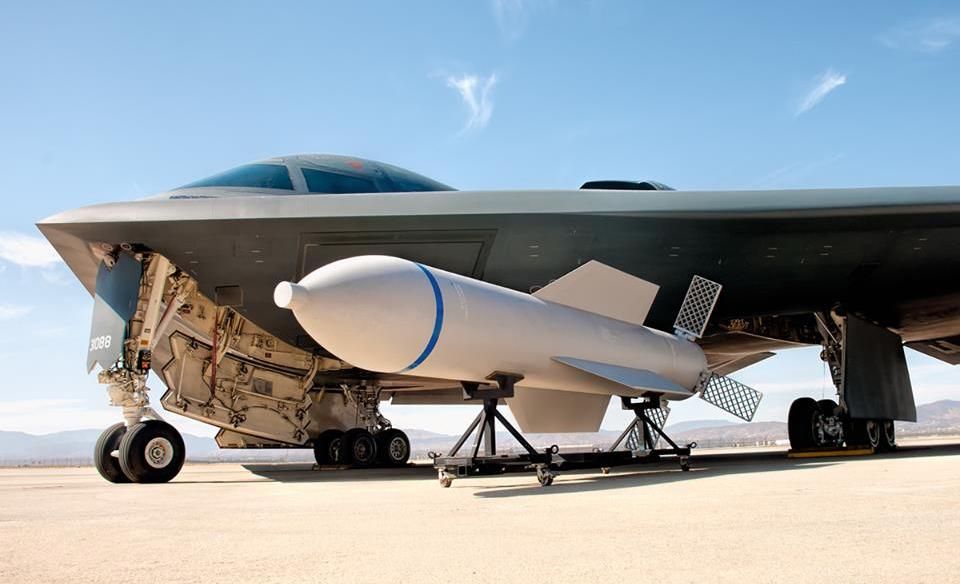
B-2 Spirit Bomber with Penetrative Warhead
The U.S. Air Force has carried out an extensive assessment of an upgraded variant of the new B61-12 nuclear bomb to ascertain its precision strike capabilities, which has included deploying the weapon from a B-2 Spirit stealth bomber with a non nuclear test warhead. The bomb is reportedly among the most versatile nuclear munitions ever developed, and deploys a relatively low payload for a tactical rather than a strategic role - meaning it is intended for use against targets such as troop concentrations, bunkers, tunnel networks and command centres rather than the destruction of entire population centres - the latter being the role of far larger strategic nuclear munitions primarily deployed from intercontinental ballistic missiles which lack the B61-12’s high precision. The newly upgraded nuclear bomb can carry out five different kinds of strike, depending on the combat situation, which include earth penetrating attacks, low yield strikes, high yield strikes, above surface detonation strikes and penetrative bunker buster strikes - all of which are ideal for specific kinds of targets. Hans Kristensen, director of the Nuclear Information Project, stated regarding the weapon’s capabilities: “The main advantage of the B61-12 is that it packs all the gravity bomb capabilities against all the targeting scenarios into one bomb… That spans from very low-yield tactical ‘clean' use with low fallout to more dirty attacks against underground targets. A nuclear weapon that detonates after penetrating the earth more efficiently transmits its explosive energy to the ground, thus is more effective at destroying deeply buried targets for a given nuclear yield. A detonation above ground, in contrast, results in a larger fraction of the explosive energy bouncing off the surface.”
The U.S. Air Force’s B-2 Spirit bombers currently deploy older and less versatile B61-7, B61-11 and B83-1 bombs, which are likely to be replaced by the B61-12 in future. Other than possibly the North Korean H-5, the upgrades provided to which remain unknown, the B-2 is currently the only bomber in the world which relies exclusively on bombs rather than more modern cruise or ballistic missiles - hence why the development of new tactics nuclear munitions remains particularly critical for this aircraft. With the B-2 itself facing numerous performance issues, including maintenance issues which have reduced its sortie rate to less than one per month, and with just 20 of the aircraft in service which are planned for retirement in the near future, the B61-12 is likely to be deployed from the upcoming B-21 Raider next generation stealth bomber - a platform expected to deploy both bombs and standoff missiles and retain considerably superior survivability to the B-2.
Deployment of tactical nuclear munitions, particularly those with specialised penetrative and bunker busting capabilities, remains a critical asset for the United States military directed at two of its major adversaries in particular - the armed forces of Russia and North Korea. Two of the United States’ four ‘great power adversaries,’ both countries rely extensively on underground fortifications and bunkers to provide survivability to their key assets. Referred to as ‘world class tunnellers’ by U.S. Defence Secretary Donald Rumsfeld in relation to the difficulties of launching military action against the country, North Korea has since the Korean War deployed extensive assets - from large munitions factories to radar systems and entire tank divisions and airfields - underground. The country’s air defence network, unlike those of Iraq, Libya, Yugoslavia, Syria, Vietnam and other states the Western Bloc has engaged in the past which deployed assets from open unfortified sites, makes use of radar and missile systems buried several meters underground - which can be raised on lifts, fire on their targets, and then return to a safe position. With the greatest fighting manpower of any country in the world, the Korean armed forces can send assets across much of the country relying on underground tunnel networks alone - a logistical asset which conventional munitions will struggle to impede. Deployment of tactical nuclear munitions is also a potentially effective means of neutralising large troop concentrations to compensate for the vast numerical disadvantage faced by the United States and its allies in the event of war. Russia’s armed forces, while making less use of underground fortifications, nevertheless remain vulnerable to tactical nuclear strikes - particularly effective in a European theatre war to destroy command centres or large tank divisions - which vastly outnumber those of the Western Bloc. With tactical nuclear weapons remaining a key asset for the United States military, in which investments continue to grow due to their considerable value and unique capabilities, the B61-12 is likely to be followed by more capable successors in the near future.
