
Alligators Come to Cairo; What Russia’s Elite Ka-52 Attack Helicopters Will Provide the Egyptian Armed Forces and their New Mistral Carriers
Military Watch Magazine Editorial Staff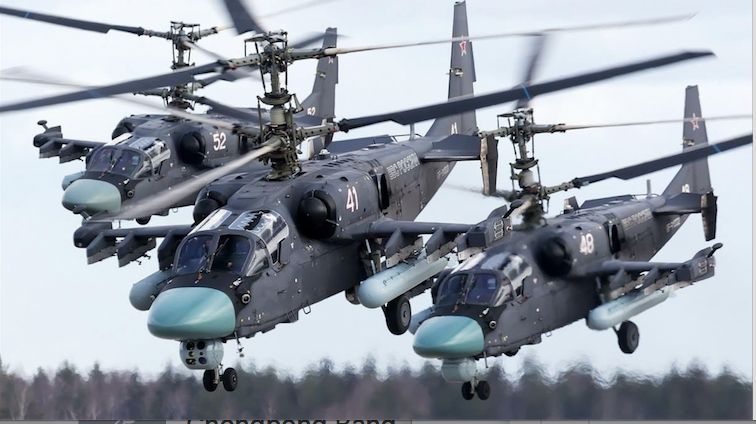
Ka-52 Attack helicopters
The only export client for the Kamov Ka-52 Alligator coaxial rotor attack helicopter, the Egyptian Air Force placed an order for several dozen of the advanced combat platforms in December 2015 amid a series of large purchases of cutting edge Russian hardware. Cairo’s decision to acquire the combat platforms was indirectly a result of the severe deterioration of Russia’s relations with the Western Bloc a year prior, which led France to cancel a contract to provide the Russia Navy with two Mistral Class carriers. With France unable to incorporate 21,000 ton warships into its own navy, and considering scuttling the vessels for a loss of well over $1 billion, Egypt offered to acquire the two ships an a considerably reduced cost. Cairo soon afterwards moved to contract Russian assistance in arming the two Mistral class ships, and with the Russian Navy having already devised an optimal means of outfitting the carriers the country played a key role in preparing the vessels for active service. With Russia having planned to operate Ka-52 attack helicopters from the carriers’ decks, Egypt went on to sign a deal to acquire almost a sizeable fleet of 78 aircraft - 32 of which were navalised Ka-52K Katran platforms and the remaining 46 which were designed as a specialised land based export variant dubbed ‘Nile Crocodile.’
The Egyptian Air Force’s attack helicopters feature a number of differences from those slated for Russian service including greater use of anti corrosion materials, likely due to the country’s harsher climate, as well as a reinforced fuselage structure and specialised landing gear designed to facilitate a greater takeoff weight. Additional cooling systems were also added to suit the African country’s hot and often humid climate. A number of other features include the OES-52 electro optical observation and laser targeting system, the President-S anti missile system and the formidable Arbalet-52 Dual band coherent pulse radar, with an Earth mapping range of 32 km and a detection range of 25 km for ground targets and 15 km for aircraft. The Egyptian Navy’s Ka-52K platforms are similar to those developed for Russia’s own navy, with each Mistral ship set to deploy eight dedicated attack aircraft and eight assault/transport variants for a total of 16 aircraft per carrier and 32 on order from Russia in total. The naval variant features folding rotor blades to save space on the carrier’s deck, a fire control system capable of operating in ‘Sea Mode’ - supporting a number of new and highly specialised munitions, as well as life support systems and special anti corrosion treated fuselage systems. It remains a possibility that the four Russian Ka-52K platforms delivered to the Russian Navy, the production of which began before France’s cancellation of the Mistral deal, could well be forwarded to the Egypt after some light modifications for service onboard the very same carriers.
The Ka-52 likely represents the most capable combat helicopter on the African continent, surpassing rival platforms across the Middle East and in many ways outperforming Egypt’s sizeable fleet of AH-64 Apache attack helicopters. A number of sources indicate that Egypt has as of mid 2018 recently received a dozen new Nile Crocodile attack platforms, which according to satellite images were deployed at the country’s Kattamia airbase. With the Egyptian Air Force fielding 19 Ka-52 aircraft by the end of 2017, the induction of 12 more would bring its fleet size up to 31 aircraft - with the military awaiting the delivery of the remaining 45 in the coming years. The ground based Nile Crocodile platforms operated by the Egyptian Air Force are set to be equipped with a primary armament of Vikr and Ataka laser guided munitions, state of the art weapons systems with ranges of 12km and 6km respectively. The composition of the naval variants’ arsenal remains unknown, and the question bearing perhaps greatest significance remains whether these carrier based platforms will be equipped with the costly but extremely lethal Kh-31 and Kh-35 anti ship cruise missiles - advanced weapons normally reserved for fixed wing fighter aircraft such as the Russian Navy’s Su-30SM. Retaining speeds exceeding Mach 3 and with an engagement range of over 100km, the Kh-31 allows the Ka-52 to function as a highly effective ship hunter - with a single strike from the missile enough to disable most warships due to the sheer kinetic energy imparted by its impact. The subsonic Kh-35, with a range of over 300km, further strengthens the Alligator’s anti ship capabilities as a complement to its shorter ranged counterpart. Equipping its carrier based Alligators with one or both of these advanced standoff munitions would be an effective force multiplier for the Egyptian Navy’s carrier strike groups, and would go a long way towards compensating for the Mistral Class’ inability to operate fixed wing fighter jets by providing a similar capability onboard a rotary wing platform.
