
Air War Over Sinai Today; How an Israeli-Egyptian Conflict for Air Superiority Over the Strategic Peninsula Would Turn Out 45 Years After the Yom Kippur War’s End - Part Two
Military Watch Magazine Editorial Staff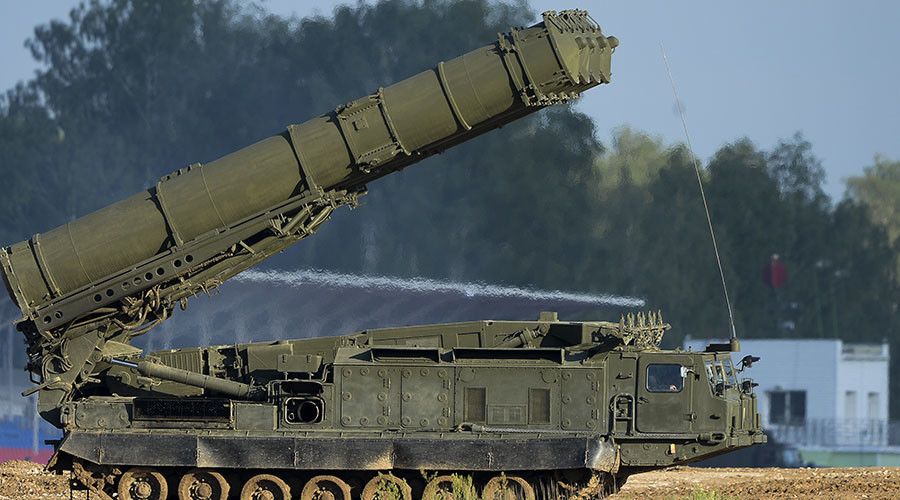
S-300V Missile Battery
A considerable qualitative advantage on the Israeli side, combined with Egypt’s aversion to losing hundreds of combat aircraft while inflicting relatively limited casualties among the Israeli Air Force, means that though Egypt’s fighter fleet is over three times the size of that of Israel it is set to remain at a disadvantage in an air war over Sinai. Israel’s higher levels of combat readiness, in light of an ongoing conflict with Syria, Hezbollah and Iran, is also set to play a key role in a war’s critical initial stages. While Israel retains a considerable advantage in the air however, its air defence capabilities, specifically those specialised in targeting enemy aircraft, leave much to be desired. With Israel facing few threats from near peer adversaries since the Yom Kippur War ended, the country has developed a considerable multilayered missile defence shield comprised of systems such as David’s Sling and Iron Dome - a potentially formidable asset against Egypt's vast North Korean sourced ballistic missile arsenal. Israeli capabilities against enemy combat aircraft however, long neglected, leave much to be desired - a reflection of a similar issue facing their Western partners. Israel’s only long range anti aircraft missile system, the U.S. made Patriot missile battery, is not only extremely limited in its range and capabilities, but more importantly is extremely unreliable in its combat performance - as demonstrated on numerous occasions. Indeed, an relatively simple Iranian drone operating in Israeli territory in February 2018 managed to evade two salvoes of fire from Patriot batteries before an Israeli helicopter managed to down the UAV - but one example of the system’s poor performance.
Egypt on the other hand fields a highly capable multi layered surface to air missile network which is as capable if not moreso against combat aircraft as it is in intercepting missile attacks. While the S-75 and S-125 used by Egyptian forces during the Yom Kippur War were restricted to 35km and 45km engagement ranges respectively, modern air defence platforms acquired from Russia are significantly more capable of protecting the country’s ground forces at far greater ranges. In 2014 the Egyptian military placed an order for S-300VM air defence systems, which were operational by the end of 2017. Israel has met delivery of such systems to Iran and potential deliveries to neighbouring Syria with great apprehension for their ability to limit the freedom of action of its air force, and with four batteries in service in Egyptian service they will pose a considerable threat to Israeli combat aircraft even at extreme ranges. The system was the first in the world capable of targeting enemy cruise missiles, aircraft and ballistic missiles simultaneously, and is equipped with advanced electronic warfare countermeasures which are likely to pose a significant challenge even to the world leading electronic warfare systems deployed by Israeli aircraft. The S-300VM retains a 250 km engagement range, and can simultaneously engage up to 24 enemy aircraft. While the S-125 and S-75 were surface to air missile platforms of the same generation as the F-4E, both belonging to the mid Vietnam War era, the S-300VM entered service decades after the F-15, F-15E and F-16 and should be able to target these platforms with impunity. Deployed to the east of the Egyptian mainland, these missile systems should give the country coverage over the entire Sinai peninsula extending partially into Israeli airspace itself.
While the S-300VM is hardly the only air defence system in Egyptian service, it is certainly the most capable and is a game changer for a conflict over the Sinai Peninsula. Other platforms including the medium range BuK and KuB, upgraded variants of the S-125 and S-75, and the short ranged Strela and Tor, provide the country’s ground forces with a multi layered defence - and considering that a number of these systems such as the BuK, Tor and Strlea are highly mobile they will provide Egyptian ground forces in the peninsula with air cover which is key to complementing the capabilities of the S-300. While Israel retains a significantly more capable Air Force, it has no comparable anti aircraft missile network leaving Egypt with considerable advantage in this field. In this way, the situation in many way mirrors that of the Yom Kippur War 45 years prior - and Egyptian air defences are likely to be key to keeping Israeli aircraft at bay to provide much needed cover for its ground forces. With this cover today extending across the peninsula, rather than being restricted to its Western tip as it was in 1973, Egypt appears to be in a considerably stronger position in this regard.
The key to Israeli forces’ victory will once again be the separation of Egyptian forces from their air defences - a considerably more difficult feat today. As Egypt is not known to fortify its missile and radar installations as other states such as North Korea have, they are potentially vulnerable to prevision strikes should they fail to intercept them. However, because the S-300VM is highly specialised in missile interception, and Israel lacks cruise or ballistic missiles comparable to the Indian Mach 3 Brahmos or the Russian Kalibr which similarly combine a high speed with extreme precision, which could thus challenge the platform’s defences, neutralising Egyptian missile systems from the air remains a considerable challenge. Launching an offensive on the ground against Egypt’s ground forces, which though inferior are far more numerous, to reach the country’s missile batteries is also an extremely difficult if not impossible task for the Israeli ground forces - particularly considering the country’s casualty aversion and the fact that Egypt’s ground force would likely enjoy extensive air support when operating within their air defence bubble - an asset Israel lacks. They key for Israel in the coming years therefore will be to acquire a more capable strike missile with standoff capabilities capable of launching long range precision strikes on enemy surface to air missile batteries should it seek to avoid being left vulnerable on its African front.
