
Air War Over Sinai Today; How an Israeli-Egyptian Conflict for Air Superiority Over the Strategic Peninsula Would Turn Out 45 Years After the Yom Kippur War’s End
Military Watch Magazine Editorial Staff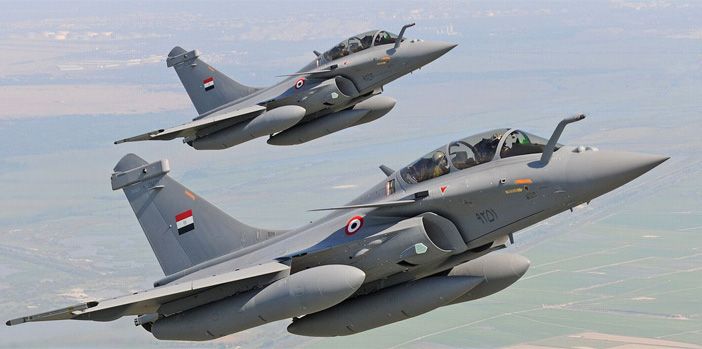
Egyptian Air Force Rafale Fighters
As previously covered, one of the most critical factors which decided the outcome of the 1973 Yom Kippur War, waged between Israeli and a number of Arab and communist states over 19 days on two separate fronts on the Sinai Peninsula and around the Syrian Golan Heights, was the contest between Israel’s elite Air Force and the Arab states’ advanced Soviet made surface to air missile batteries. With Arab air forces unable to match Israeli fighters in the skies, due in part to the superior capabilities of the F-4E Phantom twin engine air superiority aircraft over the lighter MiG-21 but primarily to the far superior calibre of Israeli pilots, advanced air defence systems provided by the Soviet Union including the S-75 and S-125 were key to providing Arab ground forces with cover against hostile air attacks.
On the African front, the larger of the two fronts where Israeli forces faced the Egyptian military, supported heavily by Algeria, Libyan and North Korean forces, the key to an eventual Israeli victory despite the strong Egyptian position in the opening days of the war came by successfully separating the Arab ground forces from their missile coverage. A decree of Egyptian President Anwar Sadat, against the strong protest of Chief of Staff Saad Al Shazly, saw Egyptian ground forces press an offensive into the Sinai peninsula beyond the range of their surface to air missile batteries - which Israeli forces took advantage of by bringing the weight of their fighter fleet to bear while counterattacking with their ground forces to break Egyptian lines, cross into the Egyptian mainland and neutralise the country’s surface to air missile batteries from the ground. With these systems destroyed, the entire Egyptian ground force and those of their allies were vulnerable to Israeli air attacks, and it was only a matter of time before Israeli forces could encircle the entire Egyptian Third Army as the Air Force begun attacks on water supplies, communications lines and other vital infrastructure - bringing Egypt’s war effort to a halt and allowing Israel to dictate terms for a ceasefire.
While Israel and Egypt today remain at peace under a tenuous treaty, in exchange for which the Sinai Peninsula was returned to Egyptian sovereignty in return for recognition of the Israeli state and the demilitarisation of the peninsula, it has often been speculated how their forces would far against one another in a potential future conflict over the strategically valuable territory linking the Middle East to the African continent. Both armed forces have evolved considerably over the past 45 years, with Egypt having shortly after the Yom Kippur abandoned the Soviet Bloc and its former allies in favour of closer ties to the West, as is strongly reflected in the change in equipment used by its military. Israel has meanwhile developed a far more capable domestic arms industry which has replaced inferior Western made platforms with superior indigenous designs, the Merkava battle tanks and Arrow missile defence system being key examples, while modifying elite U.S. made combat aircraft with indigenous avionics and electronic warfare systems to vastly improve their combat performances. Despite significant changes having taken place, the key to a future conflict is likely to still lie in each side’s ability to control the skies over Sinai - for which taking both the combat aircraft and air defence capabilities of both parties into account remains essential to predict the war’s outcome.
While the Israeli Air Force retained a slight advantage in the capabilities of its combat aircraft during the Yom Kippur War, the discrepancy between the capabilities of its fighters and those of Egypt today is considerably greater - and is set to compound the advantage Israeli pilots still enjoy in skill and combat training. Israel today fields a fleet of 59 F-15 Eagle air superiority fighters, elite twin engine heavy platforms built as successors to the F-4 Phantom which far surpass anything in the Egyptian inventory. Egypt’s Air Force by contrast lacks any air superiority fighters whatsoever, and relies on smaller and lighter designs which are considerably disadvantaged in air to air combat against the Eagle. The bulk of Egyptian aerial warfare capabilities comes from its fleet of approximately 220 F-16 Fighting Falcon light fighters and several hundred MiG-21 Fishbeds - many of which have been heavily modernised since the Yom Kippur War. The F-16 was a fourth generation fighter developed alongside the F-15 as a lighter, cheaper and less specialised complement, and its capabilities are considerably lacking compared to those of the Eagle. While the Egyptian Air Force had when aligned with the USSR been provided with the most capable combat aircraft available, the United States had adamantly refused to sell the F-15 to Cairo - instead marketing the platform to higher tier allies including Saudi Arabia and Iran. The F-16 lacks the F-15’s payload, speed, manoeuvrability, range or operational altitude, and Egyptian pilots operating the aircraft against the Israel Eagle fleet would today be at a considerable disadvantage despite their numerical superiority.
The Egyptian Air Force has since 2013, a year which saw a deterioration of relations with the United States due to allegations of Western support for the Muslim Brotherhood and moves by Washington to freeze military supplies to Cairo, invested in acquiring a number of new combat aircraft from alternative sources. The acquisition of 24 French Rafale fighter jets, a highly controversial decision given the aircraft’s extreme cost and limited capabilities, is unlikely to have an impact on the balance of power in a potential war over Sinai. The aircraft are slower (Mach 1.8 vs. Mach 2) and require more maintenance than the F-16, and have a considerably shorter air to air engagement range (under 50km vs. 75km). Though they do incorporate advanced AESA radars and have a considerable strike range, they have not been equipped with advanced long range munitions are far from a match for the far older and less costly F-15C fielded by Israel. Another Egyptian order to acquire Russian made MiG-29M twin engine fighters, heavier and more capable than the F-16 but still lighter than the F-15, may well provide the miltiary with its best chance of countering the F-15. Able to operate at high altitudes similar to those of the F-15, engage hostile aircraft at distances of up to 130km using advanced R-27ER missiles, and manoeuvre better than either the Eagle or the Fighting Falcon, they are set to prove a considerable asset. Egypt’s extremely limited experience operating the Russian fighter jets however as opposed to Israel which has operated the F-15 for over 40 years, combined with the generally poorer quality of Egyptian pilots, means the Israeli F-15 fleet is set to retain an advantage over Egypt even with the latest fighters deployed.
Continued in Part Two
