
AI-Assisted U.S. Intelligence ‘Almost Started a War’ with China Over False Nuclear Deliveries to Iran
Military Watch Magazine Editorial Staff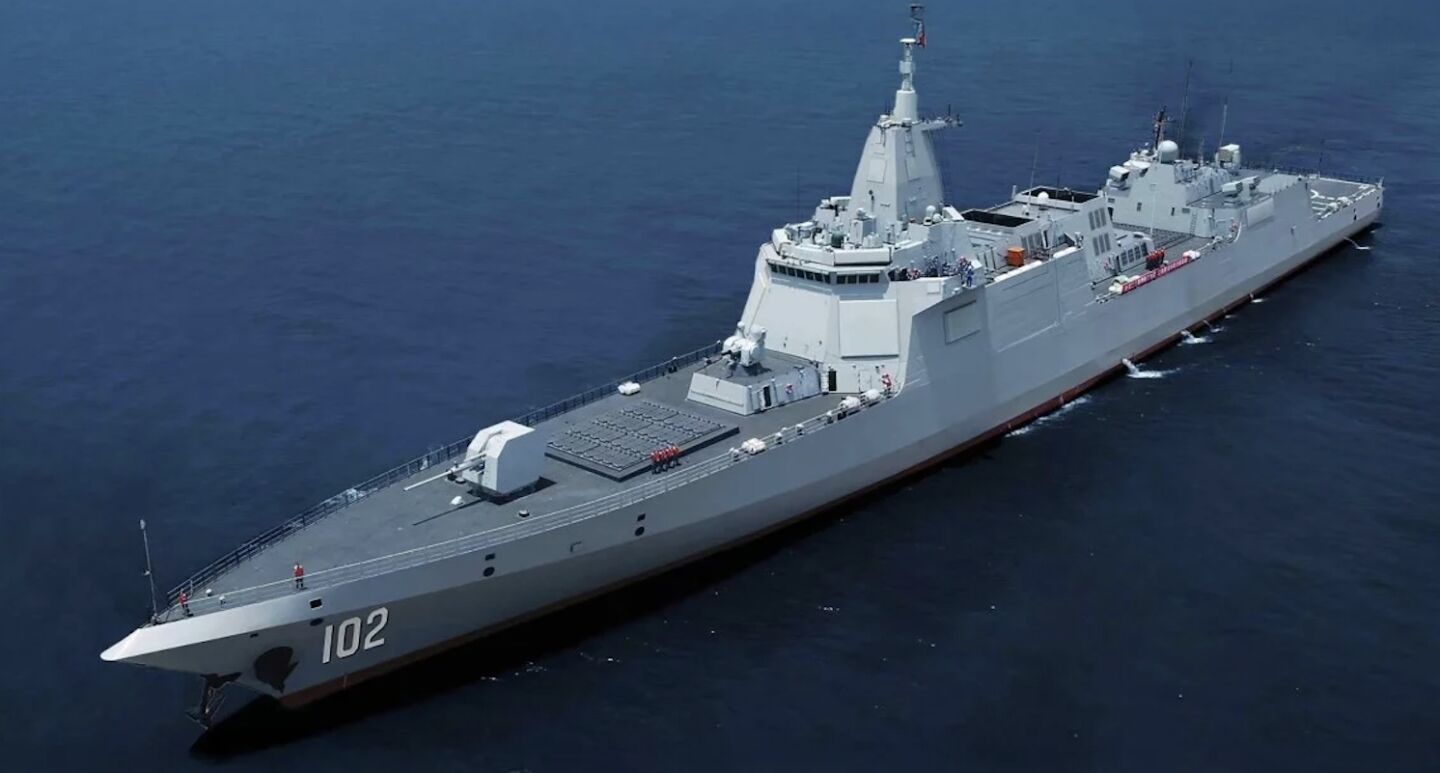
Chinese PLA Navy Type 055 Class Destroyer
An artificial intelligence-assisted U.S. military intelligence report falsely claimed that a Chinese vessel in the Middle East was transporting components connected to a nuclear weapons program, nearly prompting American forces to intercept and board the ship during the war with Iran, according to a CNN investigation. Four people familiar with the episode told CNN that the intelligence report immediately raised alarms within the U.S. Armed Forces, which began preparing an operation against the Chinese vessel. Armed personnel were reportedly preparing to board the ship, while U.S. military aircraft were already in the air.
The operation was halted only after officials examined the underlying intelligence more closely and discovered that the report had been generated with assistance from an AI chatbot. The chatbot had incorrectly identified the material being carried by the vessel. CNN was unable to determine what the ship was actually carrying. One source described the resulting intelligence assessment as “entirely false,” while adding that it “almost started a war.” An American operation against a Chinese vessel could have created a direct confrontation between Washington and Beijing, potentially escalating well beyond the original incident. The incident occurred in the spring while U.S. forces were conducting military operations against Iran.
The episode reportedly began when an analyst associated with a U.S. special operations command examined intelligence concerning the ship’s manifest. The information originated with U.S. Special Operations Command Pacific in Hawaii. Rather than relying exclusively on conventional intelligence-analysis procedures, the analyst queried an AI chatbot about the information. According to CNN’s sources, the chatbot combined publicly available information with classified signals intelligence held by the U.S. government before reaching its erroneous conclusion about the ship’s cargo. The analyst subsequently used AI a second time to transform the findings into a standard intelligence report.
That second step was particularly consequential because the resulting document was presented in the familiar format of a conventional military intelligence product. It was then circulated within the U.S. Armed Forces, where personnel acted upon its contents. “The internal tools are mostly just copies of the commercial stuff wearing lipstick,” a former senior U.S. official familiar with the AI systems used by military and intelligence analysts told CNN. The incident highlights the potential consequences of AI systems producing inaccurate information in military environments where intelligence assessments can directly influence the use of force.
Large language models are capable of producing plausible-sounding answers that contain factual errors, a phenomenon commonly referred to as AI “hallucination.” In this case, however, the erroneous output reportedly progressed beyond an isolated analytical mistake and was incorporated into an operational intelligence product. The incident occurred as the Pentagon is rapidly expanding its use of artificial intelligence. Defense Secretary Pete Hegseth has promoted an “AI-first” approach across the U.S. Armed Forces, with AI being introduced for applications ranging from intelligence analysis and targeting to logistics, budgeting and supply-chain management.
Retired U.S. Air Force Colonel Cedric Leighton, a CNN military analyst, argued that analysts still need to independently establish whether information fed into AI systems is accurate and plausible. “You still need real analysis, in order to figure out exactly what’s happening, to make sure that the data that you’re using in these AI tools is actually, first of all, true, and secondly, if it’s plausible,” Leighton said. “Those are the kinds of things that really require a lot of time, as an intel analyst, to figure out.” The episode raises questions about the security and reliability of AI systems used to process sensitive intelligence.
