
New AESA Radar Equipped Fighters in Africa? Morocco Mulls Order for Modernised F-16s
Military Watch Magazine Editorial Staff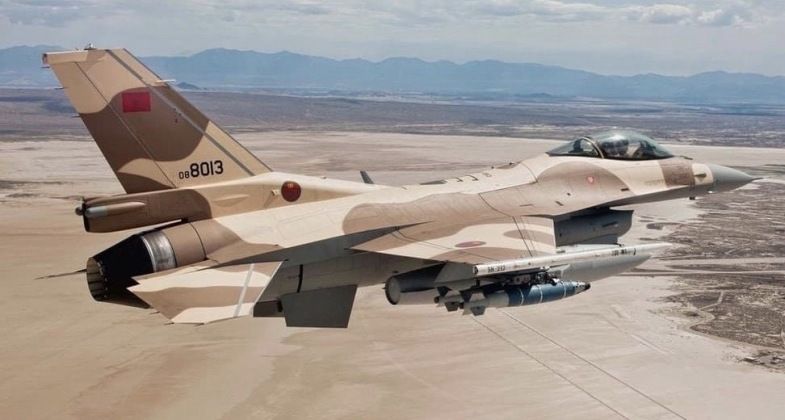
Moroccan Air Force F-16 Fighting Falcon
Alongside a large order for 220 Abrams tanks, acquired refurbished from the United States under the U.S. Army’s Excess Defence Articles Program, Morocco’s armed forces are reportedly considering the acquisition of a dozen enhanced variants of the F-16 Fighting Falcon - the F-16 Block 70/72. The Moroccan Air Force received 24 F-16C/D fighters from 2011-2012 after rejecting a proposal for the competing French Rafale, with the fighter forms the mainstay of the country’s aerial warfare capabilities. The North African kingdom also fields a sizeable fleet of F-5E Tiger and Mirage F1 lightweight fighters, which are all third generation designs considered effectively obsolete today.
The F-16 Block 70/72 has been marketed to a number of America's third world clients as a relatively inexpensive and light platform which integrates a number of high end technologies - namely advanced electronic warfare capabilities and a powerful AN/APG-83 AESA radar. Should Morocco proceed to acquire the fighters its will be among the first to field AESA radar equipped fighters on the African continent. Morocco has reportedly also shown an interest in acquiring S-400 air defence systems from Russia, although the United States has since applied considerable pressure on its allies not to make purchases of high end Russian weapons systems. With Moroccan arms acquisitions largely made with preparations for conflict with neighbouring Algeria in mind, the ability of the F-16 Block 70/72 to engage high performance fighters of the Algerian Air Force remains in serious question. Algeria’s twin engine air superiority fighters, the Su-30MKA, comfortably outperforms the F-16 in almost all parameters such as payload, sensors, manoeuvrability and endurance. This is worsened by the fact that the Algerian fleet may begin to field fifth generation stealth fighters before the first new F-16s are even delivered to Morocco, leaving the small kingdom with few options to shift the balance of power in the air in a more favourable direction.
