
Afghanistan’s Taliban Sees Resurgence in its Combat Capabilities; Deploys High End Equipment and Lasers
Military Watch Magazine Editorial Staff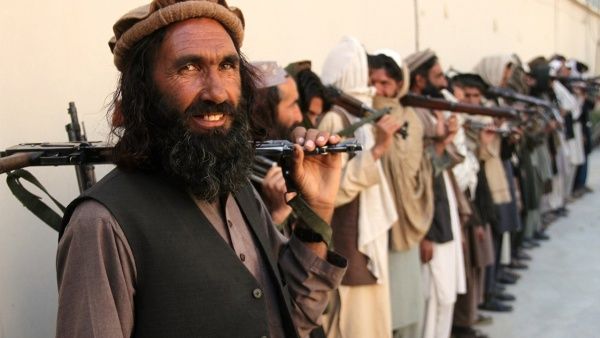
Taliban Insurgents
Afghanistan’s Taliban insurgent group, having waged a protracted war with the U.S. led Western bloc and the Western aligned Afghan government, has after seventeen years of war reportedly seen a significant resurgence in its combat capabilities. Long considered an ill equipped movement relying primarily on captured Soviet era arms from the 1980, Taliban forces have recently obtained and made use of modern equipment including night vision goggles and lasers. The insurgents have used this equipment to conduct effective night raids, tracking enemy vehicles, firearms and even personnel and more precisely coordinating their strikes on Western and Afghan government targets. Modern night fighting equipment has allowed the Taliban to more than double its nighttime operations.
Former Lieutenant General David W. Barno, who previously led the U.S. war effort in Afghanistan from 2003, stated regarding the Taliban’s new capabilities that they would significantly complicate operations for the U.S. military and its partners. “It’s going to be a problem, and it’s going to change how we operate,” Barno said. Infantry units on patrol have been forced to avoid using certain marking devices which can be easily detected by night vision equipment, while helicopter crews have been made aware that their aircraft are no longer cloaked by darkness and are as a result highly vulnerable to being targeted at night.
U.S. forces reporting on the Taliban’s new capabilities have only speculated on the origin of the insurgents’ equipment, noting that it was either captured or purchased on the black market. It remains a distinct possibility that the notoriously corrupt Afghan government security forces could have provided the Taliban with night vision, sold either directly or through a third party intermediary. The U.S. military is thus left with a dilemma, in that should they continue to provide Afghan security forces with night fighting equipment they risk continued proliferation to the Taliban but should they deny allied security forces access to such equipment they would leave their partners at a distinct disadvantage when engaging Taliban forces armed with increasingly sophisticated technologies. According to U.S. military officials, the military has regulated provision of advanced night fighting equipment to elite Afghan commandos and police special mission units to reduce the risks of proliferation.
One of the very the first batches of night vision equipment provided by the U.S. to conventional Afghan military units served as a valuable example. The equipment was sent to to the 215th Corps in Helmand province, and approximately one quarter of the devices went missing. Afghan troops reported the lost equipment as “battle losses,” but could not support their claim with any proof or records to explain why, where or when the equipment was abandoned.
Other possibilities for the sources of Taliban arms include Iran and Russia, both of which have in the past been accused by the United States of aiding the Taliban to undermine the Western bloc’s war effort. With both Tehran and Moscow currently engaged in costly wars with Islamic State and other Islamist militant groups in Syria and Iraq, which both have alleged Washington has directly assisted, it remains possible that one or both of these parties has provided the Taliban with some form of non lethal military assistance - perhaps as a signal to Washington that should it fail to cease supporting Islamist forces in the Middle East it could see reprisals including the further strengthening of insurgents in Afghanistan. The recent rise of Islamic State (IS) in Afghanistan, considered a significant security threat by both Iran and Russia, is potentially another factor which may have influenced their decisions to strengthen the Taliban and thus prevent it from losing ground to IS in the country. Ultimately the origin of the Taliban’s new capabilities can only be speculated, and it remains possible that the insurgents have looked to a number of sources to provide it with modern combat equipment. Whether the U.S. and its allies will see a significant rise in casualties in Afghanistan as a result remains to be seen, but it remains a distinct possibility.
