
Accelerating Chinese Stealth Fighter Fleet Growth: Footage Confirms J-35 Now in Serial Production at New Facility
Military Watch Magazine Editorial Staff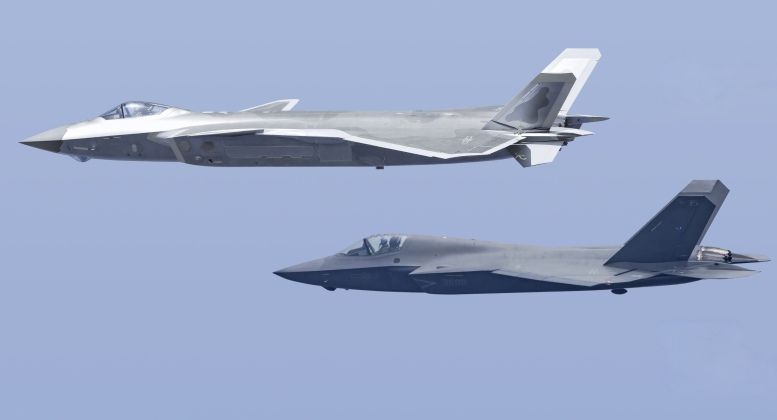
J-20 (top) and J-35 Fighters
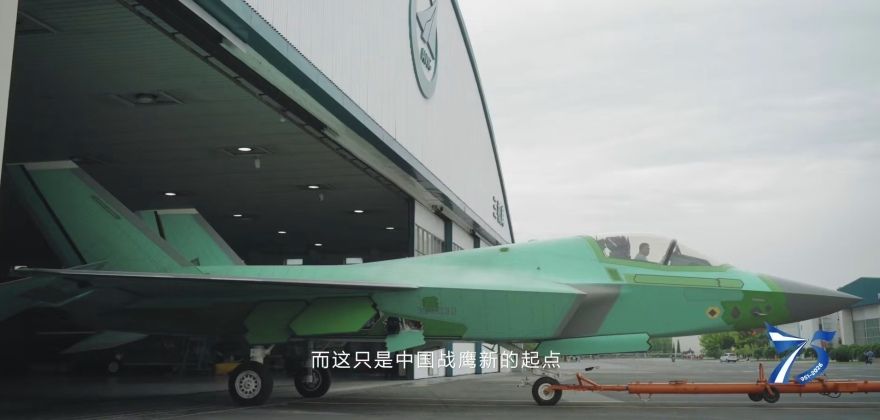
Footage released by Chinese state media sources has provided confirmation of the J-35 fifth generation fighter’s progress in serial production, with a carrier-based variant of the aircraft seen at the Shenyang Aircraft Corporation's new plant with serial number 350030 indicating that it is the 30th aircraft built. While J-35 prototypes each had a large cover next to the right air intake to conceal the access port, the production aircraft has eliminated this design, and the access port may have been reduced in size and moved near the landing gear. The J-35 was first confirmed to have entered service in both the Chinese People’s Liberation Army Air Force and in the Navy in July 2025, serving as a lighter counterpart to the J-20 air superiority fighter in the former service, and as a carrier-based fighter in the latter.
The J-35 program has made China the first country in the world to serially produce two types of fifth generation fighter simultaneously. Outside China only two other fighters of this new generation are in production, namely the U.S. F-35 and the Russian Su-57, although the former is significantly shorter ranged, less manoeuvrable and has a much smaller radar than its Chinese counterparts, while the latter is considerably behind the cutting edge in its avionics and stealth features. Although the J-35 is a shorter ranged fighter than the J-20 with a much more conventional layout, it is thought to have significantly lower operational costs and maintenance needs, which allows it to be fielded in greater numbers. The fighter is not expected to be produced on a comparable scale to the J-20, which is being procured in greater numbers by the Chinese People’s Liberation Army Air Force than any other fighter type is by any single air force.
In September 2025 Chinese state media confirmed that the radar cross section of the J-35 was smaller than a human palm, roughly that of a sparrow, which was created to its special fuselage design and metamaterial technologies. Its stealth capabilities are thought to be comparable to those of newer production batches of the J-20 and F-35, and significantly superior to those of the older F-22 and Russian Su-57. The aircraft has a maximum takeoff weight of close to 30 tons, placing it at the upper end of medium weight fighters in terms of its size, only slightly smaller than the F-22 and significantly larger than its closest foreign rival the F-35. Commenting on the fighter program, chief expert of the Shenyang Aircraft Design and Research Institute Wang Yongqing observed: "Many of our research achievements can be applied across different variants, such as sensors, onboard equipment, and avionics systems. This development model has significantly reduced both the costs and time required for fighter jet development.” “This will correspondingly reduce future sustainment costs and improve logistical efficiency,” he added.
