
Footage Shows Ukrainian Abrams Tank Taking Out Russian Infantry at Close Range
Military Watch Magazine Editorial Staff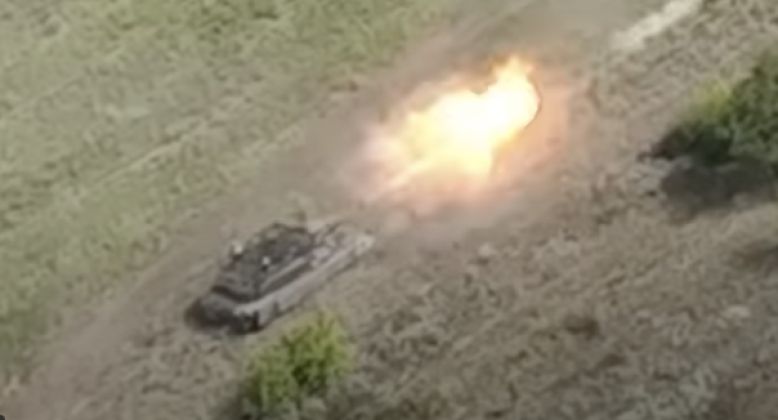
Ukrainian M1A1 Abrams Fires on Russian Infantry in Pokrovsk
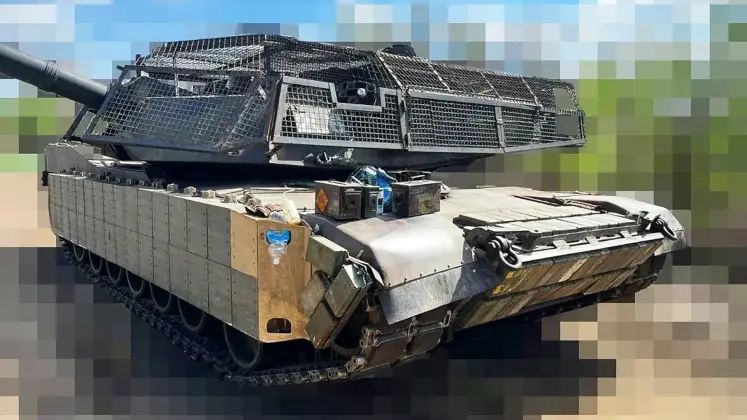
Footage captured by Ukrainian drones from the town of Pokrovsk in the disputed Donetsk region has shown a U.S.-supplied M1A1 Abrams tank operated by the Ukrainian Army successfully neutralising a concentration of Russian infantry. The tank was operated by the Ukrainian Army 47th Separate Mechanised Brigade, while supporting reconnaissance drones were operated by the 25th Separate Assault Battalion which identified the Russian personnel in a nearby building. The Abrams was able to engage the targets at close range, firing several rounds from its 120mm main gun. With remaining Abrams tanks in Ukrainian service having seen armour protection improved locally, Soviet Kontakt-1 explosive reactive armour could be seen in the vehicle, as well as increased enhanced armour on the vehicle’s engine transmission compartment and its front and rear wheels.
The 47th Separate Mechanised Brigade has consistently been prioritised to receive the most capable military equipment supplied by NATO members, including American Bradley Fighting Vehicles and German Leopard 2A6 tanks, later followed by M1A1 Abrams tanks. All three classes of tracked and armoured vehicle have taken heavy losses, with the first images of Bradleys and Leopard 2A6s being destroyed in large numbers having emerged in June just days after they were committed to the frontlines. Today the majority of Leopard 2s and Abrams tanks in Ukrainian service have been destroyed, disabled or captured. Furthermore, interviews with personnel from the 47th Brigade by late 2023 highlighted increasingly serious shortages of ammunition in the unit.
Abrams tanks only began frontline operations in February 2024, with footage confirming the vehicles took heavy losses in their first engagements with Russian forces in February-April, before they were temporarily withdrawn from the frontlines to receive more armour protection. Close to 20 out of just 31 of the vehicles delivered are estimated to have been disabled, captured or destroyed, with the class having taken major losses to drone and guided artillery strikes in particular, but also to the 125mm guns of T-72B3 tanks.
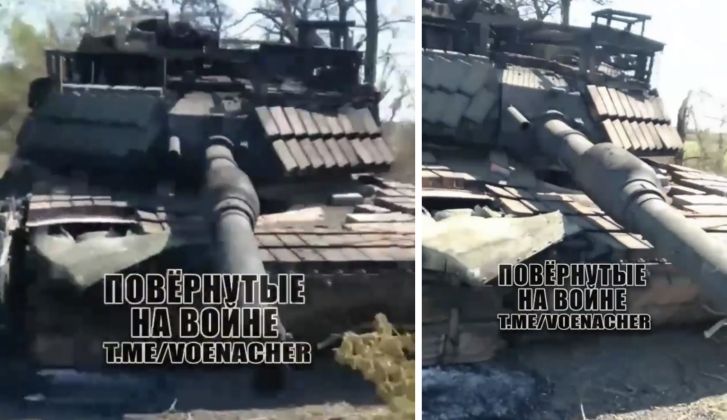
Western media outlets interviews with Ukrainian personnel have highlighted their dissatisfaction with the Abrams’ performance, citing both technical issues, including vulnerability of electronic components to condensation, as well as their vulnerability to Russian fire. The sheer size of the vehicles, which are far larger than Soviet designed tanks, has reportedly led them to attract particularly high quantities of fire, while their much larger profiles make them easier to target. Although the bulk of early kills against Abrams tanks were achieved near Avdiivka, more recently footage on August 11 showed the destruction of one of the vehicles in a drone strike in the Pokrovsk direction. The tanks have also seen limited deployments to the Russian Kursk region to support Ukrainian offensives. Footage showing an Abrams tank neutralising Russian inventory at close range in Pokrovsk provides a rare reprieve for the tank’s combat record in what has otherwise increasingly widely been considered an embarrassment both for the Ukrainian Armed Forces, which hyped the vehicles’ arrival considerably, and for American industry.
