
A Lesson from the Philippines' Rejection of Canadian Arms - The West Still Fails to Come to Terms with its Lost Monopoly on Modern Military Technologies
Military Watch Magazine Editorial Staff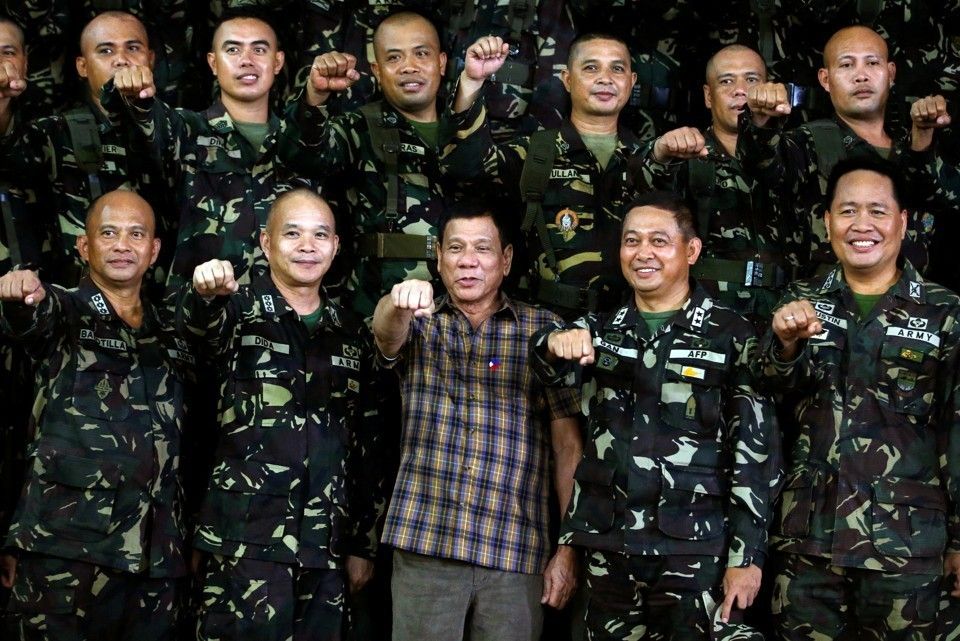
Philippines President Rodrigo Duterte with Soldiers
Philippines President Rodrigo Duterte on February 12th 2018 terminated a deal to acquire 16 Canadian Bell 412 military helicopters for $233 million following Canadian Prime Minister Justin Trudeau's attempt restrict the use of the aircraft by the South East Asian country. Citing "confusion and contradictions that have emerged recently on the intended end use of the helicopters”, Prime Minister Trudeau sought to impose conditions on the sale of its helicopters, interference in the Philippines' domestic military affairs, as a conduction for providing the platforms. This comes amid growing concern from a number of countries regarding human rights abuses conducted by the Filipino military in both their anti drug and counterinsurgency campaigns. While Prime Minister Trudeau's intent was to curb what his government perceived to be human rights violations by a potential weapons client, his actions were carried out in near complete ignorance of the realities of modern arms markets and the readily available number of alternative suppliers which, in light of the stringent and arguably overly intrusive conditions Canada sought to impose, appear far more attractive for the Filipino military.
Canada today has failed entirely to see that it is not even close to maintaining a monopoly on multipurpose utility helicopters such as the Bell 412, nor does it necessarily produce or most cost effective of them. The Philippines' inability to procure the platform from Canada will in no way hinder the country's ability to modernise its fleet, but it will cost Canada both a valuable arms contract and much of its influence with its longstanding South East Asian partner. Where Canada will not provide arms, other parties will readily fill in. Canada's actions are hardly an isolated case, nor one restricted to Ottawa's foreign policy alone, but represent a malady affecting the arms producers of the Western bloc as a whole to varying degrees - that by imposing excessive conditions on arms sales at a time of the emergence of several advanced and arguably more competitive rival suppliers they are set to lose out in arms markets.
Since the end of the Second World War the West effectively lost its monopoly on the export of modern armaments, but Western powers have largely continued to conduct policy as if this were not the case and thus made considerable losses both economic and political. The U.S. notably lost valuable potential military partners and Cold War allies as a result of its policy of denying arms to those which refused to comply with Washington's demands. Key examples in the early Cold War included Sukarno's Indoensia in the late 1940s and Nasser's Egypt in the 1950s, both founding members of the Non Aligned Movement and major regional powers which had sought U.S. arms and assistance as an alternative to those of the colonialist European powers. Both were set to become major U.S. partners and arms clients, yet both were rebuffed by Washington when they sought American arms as a result of their non aligned stances. The U.S. disapproved of a number of their policies including their relations with the Soviet Union and China, and Washington accepted loyal client states but was weary of Westward leaning neutral states. While in the pre war era Egypt and Indoensia would as a result have lacked modern armaments and likely had to accede to Western terms or else find their security compromised, with the West's loss of a monopoly on modern arms the non aligned powers were free to turn to Soviet arms to supply their needs. Both went on to become major Soviet clients. While these supposedly non aligned nations could have closely leaned towards the U.S. led Western bloc, the United States' actions led them to become close Soviet arms clients, and in turn close strategic partners as well.
Today many Western countries continue to act as if they retained a monopoly on modern armaments, denying exports to potential clients and as a result only harming their own interests. The Western bloc's arms embargo on China imposed since 1989 led it to become a major Russian and Ukrainian arms client until it could develop its own armaments industry - and eventually itself become a major exporter and competitor with Western producers. The West lost both economic benefits and soured political ties for little to no benefit. Numerous other examples exist, from the recent arms embargo on Venezuela, a major and growing client for Russian arms, to Indonesia where the U.S. embargo on spare parts for the American aircraft that the country operated led it to cease procurements of Western combat aircraft and instead become a major Russian client. Another prominent recent example has been Germany's unwillingness to sell battle tanks to Saudi Arabia and its freezing of the supply of parts and upgrades for tanks sold to Turkey over humanitarian concerns, leading both countries to look to alternative sources for their future procurements. Iran, Pakistan, Egypt, the United Arab Emirates and Argentina are other examples of states which have looked to alternative sources of arms, namely Russia and to a lesser extent China, as a result of Western suppliers failing to provide them either with the arms they requested or with parts needed to service arms already purchased.
In the case of the Philippines and Canada's imposition of extreme terms for the sale of their helicopters, Manila has again been forced not to accede to Ottawa's terms but rather to look to alternative sources for its arms. Philippines' Defence Minister Delfin Lorenzana announced upon the cancellation of the procurement deal: "We are looking at Korea, Russia, China, Turkey and other countries for the medium-lift helicopters in lieu of the Bell 412EPI." Russia's Kamov, China's Harbin Z-9 and South Korea's KAI KUH-1 Surion all fulfil comparable roles - arguably far more cost effectively. In October 2017 a Russian Naval Flotilla docked in Manila harbour providing free security weapons for the country's armed forces, including 5000 AK-74M Kalashnikov assault rifles, 20 armoured vehicles and 1 million rounds of ammunition. Unlike the West, Russia's approach wins markets and good will where the Western approach appears to be losing both. Today competition has arisen from beyond Russia, with the Koreas, China and Japan all providing highly sophisticated weapons which can rival and often outperform their Western counterparts. Ultimately several Western nations' perception that they can afford to impose terms on arms deals is set to continue to cost them dearly. Since 1945 the idea of a Western monopoly on the export of modern military technologies has been seriously challenged. When the first Russian, Korean or other helicopter lands in the Philippines to take on the roll Canada's Bell 412 would have, this message will only be further reinforced.
