
A Great and Terrible Day for the F-35; New Stealth Jet Marks First Combat Mission - And First Loss
Military Watch Magazine Editorial Staff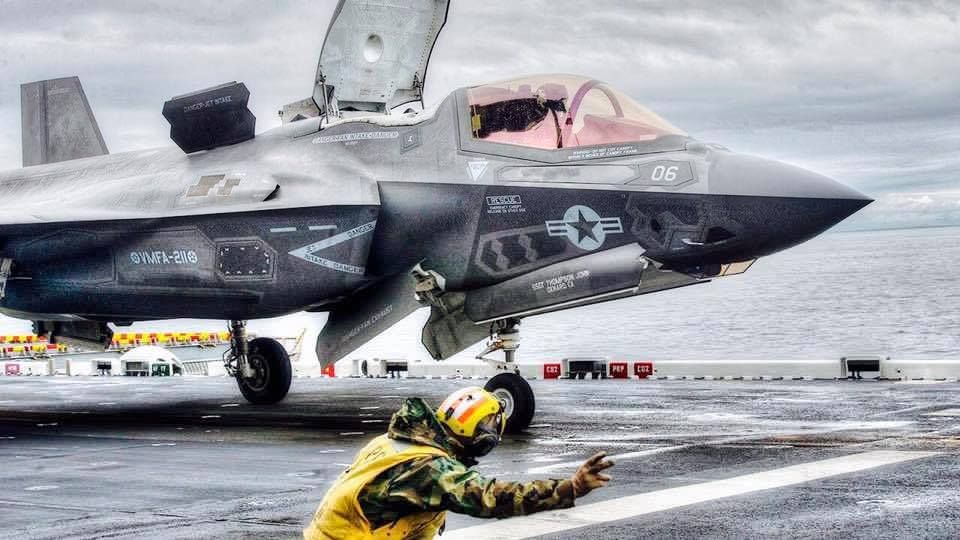
F-35B Stealth Fighter on Carrier Deck
The U.S. Marine Corps have reportedly deployed the F-35 Lighting II fifth generation single engine light fighter on its first ever combat mission, with the stealth fighters laying down fire on Taliban insurgent forces in Afghanistan. The F-35B, the highly specialised variant deployed by the Marine Corps integrating advanced short takeoff and vertical landing (STOVL) capabilities to allow it to operate from lighter carriers such as the Wasp and America Class, was deployed from the Wasp Class carrier USS Essex for strikes on September 28th. The F-35B was the first variant of the new stealth fighter to be declared operational, which occurred four years prior in late 2014, though as of 2018 no F-35 variants have yet successfully completed the required tests under the System Demonstration phase (SDD) - indicating that there remains a long way to go before the jets are fully combat ready. Nevertheless, the United States military appears to have shown enough faith in the fighter’s capabilities to allow it to carry out airstrikes against Taliban forces - with the insurgents' lack of even the most basic anti aircraft capabilities ensuring that risks involved in the airstrike remain comparable to those of a training exercise.
While it may have come at a cost, namely the lowering of standards and termination of a number of test points formerly needed to approve the fighter for production, the F-35’s first combat operation represents a significant landmark in the fighter’s development. For a weapons program notorious for delays and poor reliability, a combat operation can be perceived as an encouraging sign that the F-35 is a potentially very real threat to the enemies of the United States once it is working. When the A and C variants of the stealth fighter, operated by the Air Force and the Navy respectively, will see their first combat operations, remains to be seen - though for the C variant it is likely that such operations will not commence until the 2020s. Speaking regarding the F-35’s combat operation, commander of U.S. Naval Forces Central Command Vice Admiral Scott Stearney stated: "The F-35B is a significant enhancement in theater amphibious and air warfighting capability, operational flexibility, and tactical supremacy… As part of the Essex Amphibious Ready Group, this platform supports operations on the ground from international waters, all while enabling maritime superiority that enhances stability and security."
While there is good news for the F-35, the second fifth generation fighter in the world to ever see combat, September 28th also marks one of the greatest considerable losses since the aircraft first entered service. An F-35B fighter crashed just hours after the Afghan combat operation took place, which notably marked the first crash of an F-35 jet. While the fighter’s pilot ejected safely, the F-35B jet itself was lost. As the F-35B is by a considerable margin the most expensive combat aircraft in production anywhere in the world, coming at over $130 million per aircraft, the represents a considerable loss. The military as of yet remains uncertain as to the cause of the crash, and while the fighter’s safety record is considerably superior to those of its fourth generation predecessors - the F-14 and F-15 in particular - it nevertheless remains cause for concern.
