
A Carrier Power Restored; What the F-35B Stealth Fighter Will Do For Britain’s Armed Forces
Military Watch Magazine Editorial Staff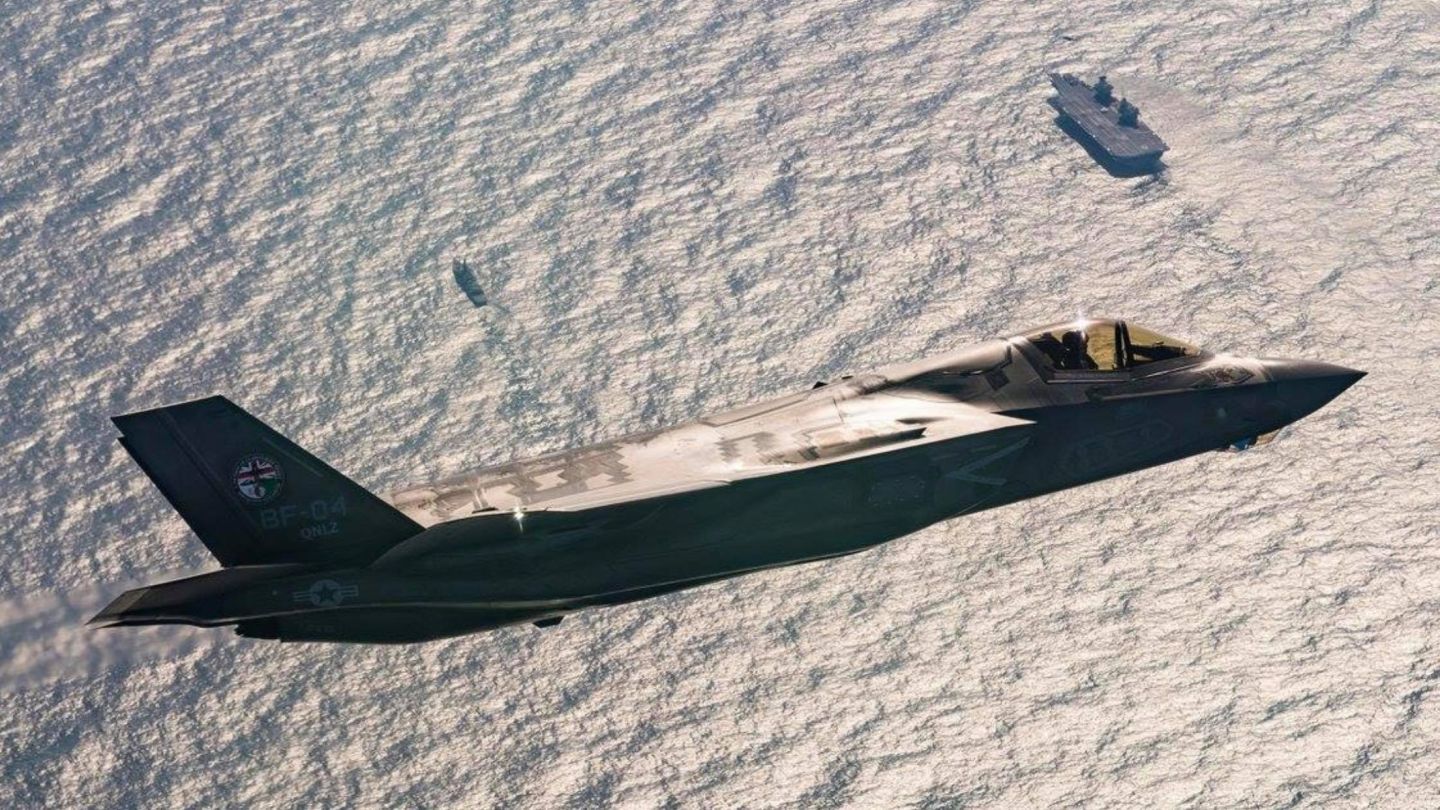
British Royal Navy F-35B Stealth Fighter Above Carrier HMS Queen Elizabeth
Britain’s sole aircraft carrier HMS Queen Elizabeth has received its first F-35B single engine light fighter jets, marking the first event of its kind in decades since the commissioning of the Harrier jet onboard the Invincible Class light carriers during the Cold War. The Queen Elizabeth Class ships, of which two are planned, are only able to operate a single type of fixed wing aircraft - with the F-35B retaining specialised short takeoff and vertical landing (STOVL) capabilities. Reliance on the F-35B has spared the British Royal Navy with the additional expense of operating steam or electromagnetic catapults for its fighters, used on U.S. supercarriers to launch the conventional carrier based variant F-35C, or arresting gear needed for conventional carrier based landings. This has come at a cost however, preventing the warships from operating other carrier based fixed wing aircraft such as AWACS platforms, analogous to the American E-2 Hawkeye or Chinese KJ-600, carrier based tanker aircraft such as the MQ-25 or carrier onboard resupply aircraft such as the C-2 Greyhound.
The F-35B is a multirole fighter primarily designed for a strike role, hence its name Joint Strike Fighter, while also retaining limited defensive air to air capabilities. The aircraft can deploy up to four air to air missiles or two large bombs from internal storage, with the platform’s need to retain a radar cross section reducing stealth profile limiting its payload. The aircraft is notably extremely costly and time consuming to maintain, moreso than any other fighter currently in production anywhere in the world including the variants deployed by the U.S. Navy and U.S. Air Force - the A and C. They are also the most costly fighters to acquire of any platform currently in production, at little over $130 million per jet due to both the extreme complexity of STOVL technologies and the low numbers of fighters planned for production - particularly relative to the F-35 which, with several thousand planned, is expected to cost under $85 million per fighter.
The F-35B represents a considerable upgrade over the Harrier jet which the Royal Navy previously relied on for power projection, with cutting edge sensors and radar evading capabilities and the ability to deploy many of the most advanced munitions ever designed in the West. These include the AIM-120C air to air missile and the upcoming AIM-120D and Meteor missiles, which are key to ensuring the aircraft’s viability in air to air combat against near peer adversaries. While considerably slower, lower flying and less heavily armed than the Eurofighter Typhoon which currently comprises the mainstay of Britain’s air fleet, the F-35 is superior in a number of respects - primarily in terms of its sensors and radar evading capacities. It notably integrates an infra red search and track system also found on the Eurofighter and the U.S. Navy’s F-18E Block III Super Hornet, but lacked by its predecessor the harrier or its heavier counterpart the F-22, which serves as an invaluable asset in countering enemy stealth fighters such as the Russian Su-57. The F-35B is set to fulfil a complementary role alongside the Eurofighter, and is intended to replace the Navy's Harrier GR9 and Air Force's Tornado GR4. The Eurofighter itself may eventually be replaced by the Tempest fighter, should it materialise, though this is not expected until at least the mid 2030s.
Britain currently fields approximately twelve F-35B jets, thought this number is expected to increase considerably with 138 jets planned. Each Queen Elizabeth Class carrier is expected to accommodate 40 fighters alongside accompanying rotary wing platforms, though whether the full number of F-35 jets will be purchased remains in serious question given their considerably cost - which has increased considerably since the British pound lost value relative to the U.S. dollar. Involvement in the F-35 program has nevertheless provided the British Royal Navy with high end power projection capabilities unmatched since the Vietnam War era, the last time the country fielded full sized warships with high end fighter jets -the F-4 Phantom. As the only tier one partner in the F-35 program, and with invaluable expertise in thrust vectoring technologies originally used on the Harrier jet, Britain has been responsible for manufacturing approximately 40% of the F-35B - a major boost to British industry which has not developed a fully indigenous fighter jet in several decades.
