
Russia Conducts Operations to Recover Su-33 and MiG-29 Fighters Lost at Sea
Military Watch Magazine Editorial Staff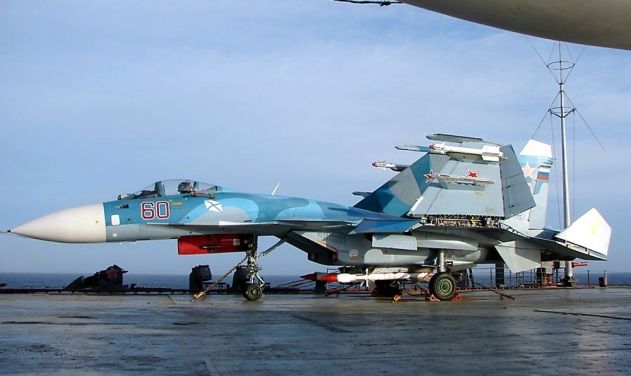
Su-33 Fighter Aboard the Admiral Kuznetsov
In perhaps it's most prolific operation since the fall of the USSR, Russia's naval operations in the Mediterranean Sea to provide air support for Syrian government forces, including the deployment of its sole Admiral Kuznetsov class aircraft carrier, drew much attention in early 2016. The deployment of an aircraft carrier to launch sorties against insurgent groups, though it contributed significantly to Russia's prestige as a major naval force capable of projecting power far from its borders, did not go as smoothly as planned. Russia was one of only three nations to deploy carriers for combat operations overseas in recent years, the other two being the United States and France. Unlike U.S. and French carriers however, the Kuznetsov class was not nuclear powered and had a limited range, making it less than ideal for power projection so far from the country's borders and necessitating several refueling stops.
Aside from the Kuzentsov's lack of nuclear power Russia's lack of experience in conducting carrier operations also became apparent when operating off the Syrian coast. The Kuznetsov was the first and only conventional carrier to enter Russian or Soviet service, with previous ships such as the Kiev class relying solely on fighters capable of vertical takeoff such as the Yak-141. While the fighters embarked on the Kuznetsov, the MiG-29KR and particularly the Su-33, are perhaps the most advanced carrier based fighters in the world, the carrier itself proved somewhat unremarkable. During operations, the carrier lost one Su-33 and one MiG-29KR - both of which reportedly fell into the sea. The two accidents occurred within a month of one another in November and December 2017. Problems with arresting gear were cited as the cause.
Prior to its deployment to Syria the Admiral Kuznetsov's air wing received significant upgrades to its capabilities - some of Russia's latest technologies. The MiG-29KR was a highly upgraded variant of the original MiG-29K, one of the latest fighter's to enter service in the Russian military. The loss of two such fighters and the potential for them to be recovered by a rival powers such as the United States, which maintains a sizable military presence in the region, risked the loss of valuable technological secrets. As a result Russia deployed a Yantar oceanographic research vessel in a recovery operation. According to Russian state media, critical parts of the fighter's were recovered from the seabed - and it is likely that whatever remained was destroyed to prevent it falling into the wrong hands.
With Russia's next generation SHTORM supercarrier unlikely to be commissioned in the near future due to the country's economic difficulties, and many planned modernizations on the Kuznetsov cancelled for the same reason, Russia is set to remain an intermediate carrier power alongside India, France and Britain - all of which are far eclipsed by the carrier capabilities of the United States. It is only China which, due to its economic growth and military modernization program, has the potential to become a leading carrier power alongside the U.S. This growth itself has been heavily reliant on Russian technology, with both the Liaoling and the Type 001 being heavily based on Russia's Kuznetsov class. While Russia's technological capabilities in many fields, including possibly in carrier based aircraft, are second to none, a combination of its lack of experience in carrier operations and its lack of an economy capable of sustaining a large carrier fleet remain serious constraining factors.
