
How Capable is Venezuela of Defending its Airspace? Part Two
Military Watch Magazine Editorial Staff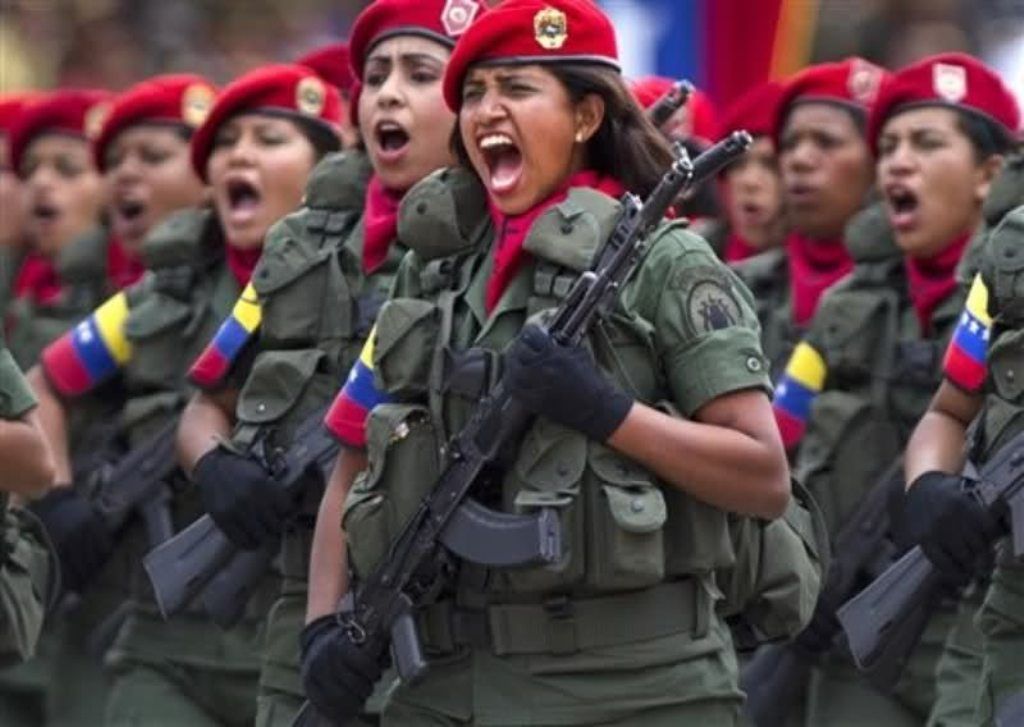
Venezuelan Female Soldiers
Unlike any air campaign launched in U.S. history, American aircraft operating over Venezuelan airspace would face both state of the air surface to air missile systems and some of the world's most advanced fourth generation air superiority fighters - superior to any fourth generation capabilities fielded by the United States itself. In such an environment the vast majority of U.S. aircraft would be unable to operate and the country would be forced to rely on cutting edge capabilities - namely the F-22 stealth air superiority fighter and B-2 stealth bomber - to have any chance of neutralising Venezuela's defensive capabilities from the air to avoid suffering overly extensive losses. While the United States Air Force lost around 30 aircraft to antiquated Iraqi air defences from the 1950s, 1960s and 1970s these very same fourth generation legacy aircraft - which still compromise the vast majority of the U.S. fleet - cannot be expected to engage the advanced Russian systems developed half a century later deployed by Venezuela without suffering very heavily.
An air campaign to neutralise Venezuela's air force and air defences would be far more taxing for the US Air Force than anything attempted since the Vietnam War. With only 187 F-22s and 19 B-2s in service, deploying these capabilities to South America in sufficient numbers would necessitate their withdrawal from more pressing fronts such as East Asia and Europe. The F-22 in particular, a fighter incapable of operating from carriers and lacking the range of the B-2, would ideally need to be deployed from airbases near Venezuela. With no known U.S. airbases in Central or South America this would most likely be impossible. The F-22s would therefore need to refuel in the air and possibly even carry external fuel tanks to be able to reach Venezuela from the U.S. mainland, leaving them highly vulnerable both to being detected before entering Venezuelan airspace and to being stranded and lost should their tankers be destroyed. While the carrier based F-18 fighters would be ideally suited to launch sorties against the coastal state, lacking the stealth and air superiority capabilities of the F-22 they would be unable to operate against Venezuelan Su-30MK2 air superiority fighters and S-300VM and Buk-M2E SAM systems and so would be unsuitable. Without support from F-22s or any other fighters, B-2 bombers operating alone would be inadequate and vulnerable without a fighter escort - meaning that the most feasible option would most likely be to deploy F-22s with tankers despite the risks.
The high end technologies in Venezuela's arsenal give it the potential to be one of the most challenging targets to attack by air. However as repeatedly demonstrated in previous wars, the performance of a country's air force and air defences depend highly on morale and training of SAM crews - the state of which for Venezuela is yet to be seen. Should the oil rich South American nation's military prove to be like that of Iraq and abandon their weapons on the field, turn off their SAM systems' radars at the sight of American aircraft, or even defect in their fighters to neighbouring countries then Venezuela's air defences could prove to be a paper tiger. This also applies to training, as even in an aircraft like the Su-30MK2 a poorly trained pilot would struggle against less capable aircraft designs such as the F-15 or even the F-18, while proper training for SAM crews would also prove critical for them to operate effectively.
Should Venezuelan air defence operators prove capable, as those of Yugoslavia did before them, they may well exact losses against the U.S. Air Force at a rate unprecedented since the Second World War. During the Kosovo War Yugoslav crews demonstrated excellent training and morale as well as ingenuity, not only standing firm against an overwhelmingly more powerful adversary but also studying stealth technology and managing to make use of a small arsenal of supposedly obsolete weapons to neutralise two American stealth fighters. Venezuela, unlike Yugoslavia, operates far more advanced weapons systems and should their air defence forces prove to be similarly competent - combined with their highly advanced technological capabilities they would likely be able to repel or else exact very heavy losses on American aircraft - including the most modern and survivable stealth fighters. If a skilled operator can down stealth fighters with an Su-125 from 1961 using special modifications, they can certainly do so with several batteries of the far more advanced S-300VM in service since 2013 and the similarly advanced Buk-M2E. Should Venezuelan SAMs or fighters down American F-22 fighters or B-2 bombers it would be a disaster for the image of the American military and for the prestige of the country's arms industry. These cutting edge aircraft are the crux of America's technological advantage in aerial warfare, and have notably long been out of production. Their loss would impair U.S. military capabilities for decades until a new generation of replacements enter service - or else force the United States to spend billions of dollars to restart production and replace these aircraft. Ultimately the risks to the United States' global power will likely prove far too great to risk testing Venezuela's military - and the United States will need to rely on covert means, support for opposition movements and economic sanctions should it seek to depose the Venezuelan government. Against the Venezuelan state, whose intelligence services are far from world leading and whose economy has proven fragile, military strikes to confront its advanced air defence forces appear to be the most difficult and by far the most risky means of bringing about regime change. So long as the country's air force and air defence capabilities remain in service therefore, U.S. military action against the country remains unlikely.
