
60 Years of Air to Air Missiles; How the U.S. Modified Taiwanese F-86 Fighters to Deploy AIM-9 Missiles Against China
Military Watch Magazine Editorial Staff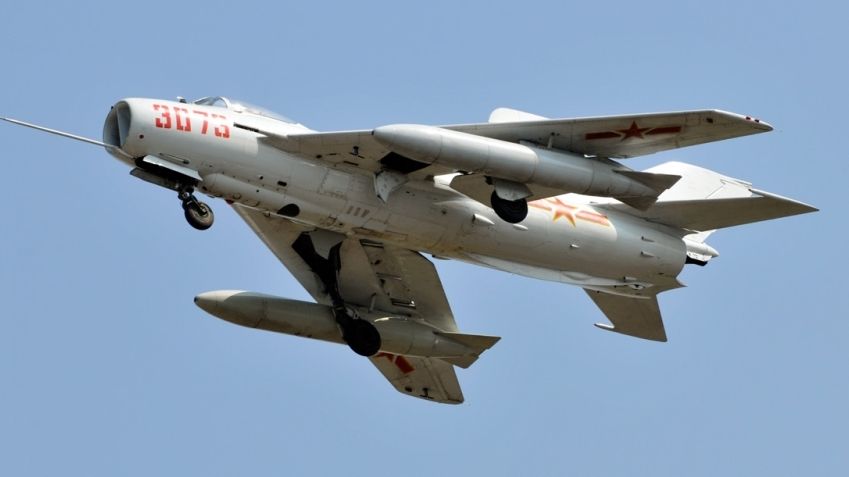
Chinese J-6 Fighter - the first in the PLA to deploy air to air missiles
During the Cold War air to air missiles came to play an increasingly key role in aerial warfare across the world, and beyond visual range air to air combat is today the predominant form of aerial engagement for which all major aerial powers train. While the first air to air missiles were developed to give fighters an advantage in visual range engagements, as technologies improved aircraft developed the ability to engage targets at beyond visual range, and later at extreme ranges. While initial air to air missiles had ranges of just a few hundred meters, and were designed to give fighters an edge when dogfighting, the longest ranged air to air missile in service today, the Russian R-37 deployed for its MiG-31 interceptors, can engage hostile aircraft at ranges of approximately 400km. As air to air missiles evolved, they adapted to changes in warfare with new capabilities - from the ability to manoeuvre in flight to target more manoeuvrable fighters to the ability to employing more advanced electronic warfare countermeasures and tracking systems.
September 2018 marks 60 years since the first deployment of air to air missiles in combat, which took place during the Second Taiwan Strait Crisis. Five years prior, MiG-15 fighter jets from China and North Korea had enjoyed a considerable capability advantage over the U.S. Air Force’s F-86 Sabres over the skies of Korea - which was heavily compensated for by the considerably superior experience and training of American pilots who had waged numerous air campaigns in Europe and the Pacific, allowing them to contend with the neophyte Chinese and Korean airmen despite their inferior jets. Over the Taiwan Strait however, China’s People’s Liberation Army Air Force appeared set to retain a considerable advantage. Not only had five years provided considerably time to train highly capable pilots, but it had also received yet more capable MiG-17 fighters, as well as their indigenous variant the J-5. Against these Taiwanese military aviation, officially the Republic of China Air Force, was wholly unable to contend. Taiwanese pilots lacked the experience of their American counterparts, and when flying U.S. made F-86 jets against the Chinese Air Force they were at a considerable disadvantage.
With the United States heavily invested in ensuring a continued presence in the Taiwan Strait, for which a strong Taiwanese air arm was essential, the U.S. Navy embarked on Operation Black Magic - a secret effort to enhance the first generation F-86 jets with air to air missiles. The newly developed AIM-9 sidewinder, which had entered service two years prior in 1956, was delivered to the Taiwanese Air Force while American technicians worked to heavily modify the F-86 to be able to deploy the platforms. The first combat use of air to air missiles in history was on September 24th 1958, when Taiwanese pilots deployed them against the more capable Chinese jets. Chinese fighters regularly cruised above Taiwanese F-86 jets, making use of their superior altitude and immune to the Sabre’s cannons. MiG-17 jets flying past the Sabres, supposedly immune to attack, thus found themselves suffering heavy losses - and the formerly near total advantage enjoyed by the PLA Air Force was thus seriously undermined. This development was key to allowing U.S. aligned Taiwanese forces to contest air superiority.
While the deployment of the AIM-9 was a considerable setback for the PLA, and the combat test provided American observers with valuable information on the performance of their new weapons systems, China’s armed forces were able to derive a considerable benefit from the incident. One of the Taiwanese AIM-9B missiles which hit a Chinese MiG-17 failed to explode but lodged in they airframe - allowing the PLA jet to return to base with the missile safely in place. With China’s military industrial base reportedly negligible at the time, the weapon was passed on to the Soviet Union. Soviet engineers said that the captured missile served as a "university course" in missile design, and the revolutionary AIM-9 was reverse engineered and manufactured as the R-3 air to air missile - also known as the K-13. The Chinese People’s Liberation Army Air Force would four years later in 1962 induct its first second generation fighter, the MiG-19, into service, which they would domestically produce as the J-6. The J-6 was capable of deploying a number of advanced air to air munitions, and the R-3 was produced in China as the PL-2 at the same time as the new fighter jet - with each aircraft deploying up to four of the short ranged missiles.
The race to develop the most capable air to air missiles continues to this day, with China, the United States and Russia leading the field. As for the AIM-9, it remains widely in service today with the AIM-9X Block II currently under development for America’s foremost fighter jet, the F-22 Raptor, fielding 'lock on after launch’ capabilities designed specifically to allow the aircraft to better engage supermaneouverable enemy fighters in visual range. The more capable Block III variant of the AIM-9X is currently under development, and further advancements in air to air missile technologies are set to continue to prove key to determining which party can claim superiority in air to air engagements for the foreseeable future.
