
Defending the Skies for 40 Years; Evolution of Russia’s S-300 Air Defence System - Part Two, S-300PMU and S-400
Military Watch Magazine Editorial Staff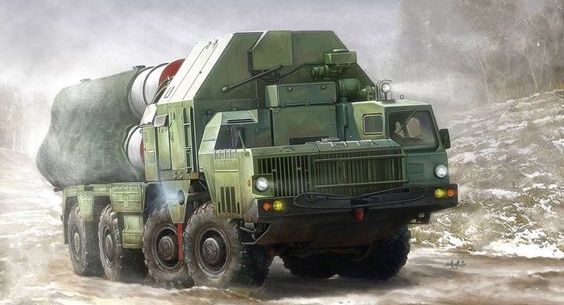
S-400 Surface to Air Missile System
The S-300PMU-1 entered service in the Russian military in 1992, just months after the Soviet Union’s disintegration, and the new platform revolutionised the capabilities of the already highly sophisticated system. The new air defence system was the first in the world to deploy several different kinds of missiles simultaneously. These included the advanced 48N6E missiles with a phenomenal 195km engagement range, more than double that of the original S-300P, and a large 150kg warhead. The missiles travelled at speeds of little over Mach 5.8, allowing them to intercept even supersonic missile attacks while also making them considerably more difficult to evade for enemy aircraft. Two new lighter and shorter ranged missiles, the 9M96E1 and E2, were also used to engage closer targets, with the former retaining an 40km maximum engagement range and the latter a 120km maximum engagement range. The use of these missiles made the PMU-1 a highly versatile system equipped to optimally engage targets at both intermediate and short ranges and and both medium and high altitudes. The missiles have an extremely high probability of kill, higher than that of longer ranged platforms, due to their use of a gas dynamic system for manoeuvring rather than aerodynamic fins. This is despite their smaller warhead and weight.
Complementing the air defence system’s superior missiles and engagement range, the S-300PMU-1 incorporates a new and more capable 30N6E radar to facilitate more effective long range engagements. A single system is capable of simultaneously tracking and engaging up to six targets, a 50% increase over its predecessors. Improving over the capabilities of the PMU-1, the S-300PMU-2 entered service in 1997 largely as a refinement of its predecessor. The system’s maximum engagement range improved slightly, as did the maximum range at which it could target adversaries, and it thus became the first platform in the series capable of targeting intermediate range ballistic missiles. The systems’ command post, missile storage and maintenance suite, radar and electronic warfare systems were all markedly improved. Individual firing units also gained the ability to operate autonomously by deploying the self propelled 96L6E acquisition radar.
The S-300PMU-2 was largely a stepping stone towards developing the S-300PMU-3 - a platform intended to revolutionise Russia’s long range air defence capabilities with a performance far outshining those of its predecessors. With Russia having often renamed advanced variants of older weapons systems in the post Soviet era to reflect their sophisticated capabilities, the Su-30 and MiG-33 fighters being key examples, in part also as a marketing ploy to better sell these weapons overseas, the S-300PMU-3 was similarly renamed S-400. This system emerged as very likely the most prolific air defence platform of the 21st century, which has made headlines across the world. The S-400 was in fact designed as a further development in the S-300P family - and this is strongly represented in its capabilities. Entering service in 2007, the S-400 fields four types of long range surface to air missiles including the 400km range 40N6, the 250km range 48N6, the 120km range 9M96E2 and the 40km 9M96E. In this way, S-400 batteries are capable of providing considerable multi layered air defences all on their own - though they still benefit from support from more specialised intermediate and short ranged systems such as the BuK-M3 and Pantsir. Rival systems such as the U.S. Patriot and THAAD are not only restricted to far shorter ranges, 160km and 200km respectively, but they lack the ability to engage as many targets and can deploy only a single interceptor missile type - thus lacking the versatility and multi layered protection of the S-400.
A single S-400 system comprised of eight battalions can control a maximum of 384 surface to air missiles from 73 launchers. With missiles fired by a gas system from their launch tubes, which projects them approximately 30 meters into to air before the rocket motor ignites, a highly sophisticated version of the hot launch vertical launch system, the maximum range of the system’s missiles increases while its minimum range falls considerably. One of the most prominent features of the S-400 is its deployment of the 40N6E missile, a platform unparalleled in its capabilities which travels at speeds of Mach 15 and at extreme altitudes to reliably strike targets up to 400km away. The missile is programmed with an active radar homing head which, after climbing to the designated altitude, switches to search and destroy mode and can strike enemy missiles and aircraft well over the horizon with a high lever of precision. The 40N6 is also capable of reliably engaging faraway targets at altitudes as low 5 meters, and can manoeuvre at 20g.
The range of the S-400’s 40N6 missiles has made it an invaluable and much sought after asset - with this missile alone serving as a potential game changer in a number of theatres. Providing China’s People’s Liberation Army for example with the ability to target hostile aircraft over almost the entire territory of Taiwan is considered by a number of analysts as one of the key reasons why Beijing was so quick to place orders for the system - which made it the S-400’s very first foreign client. Striking well beyond standoff range, hostile fighters and high value airborne targets such as AWACS, tankers and command posts will all be highly vulnerable to attacks from 40N6 missiles. This has left large and unmanoeuvrable aircraft - which formerly relied on operating from beyond targeting range - effectively obsolete, thus leading to calls within the U.S. military for these aircrafts’ swift retirement. The S-400 has been a major game changer in this regard.
Another defining trait of the S-400 system is its ability not only to detect, but also to lock on to, stealth aircraft. The weapons system's powerful 91N6E radar is key to providing this capability, and has made the S-400 a key asset for a number of states expecting to face next generation fighter aircraft and other radar evading platforms. The radar system can reportedly lock onto and target stealth aircraft at ranges over 150km. The U.S. military has specifically marked the proliferation of the S-400 as a major threat to its power projection capabilities - a result of the country’s heavy reliance on stealth aircraft to penetrate enemy airspace. The weapons system’s combination of speed, precision, accuracy and range makes it a major danger to enemy aircraft, ballistic and cruise missiles. Whether the S-400 will be the final addition to the S-300P family remains to be seen, but the platform could very likely see more advanced variants enter service in future - possibly incorporating a number of technologies from the even longer ranged and more sophisticated S-500.
Continued in Part Three
