
China's Air Force Inducts Five Y-20 Heavy Strategic Airlifter into Service; The Significance of Growing Transport Capabilities in the PLA
Military Watch Magazine Editorial Staff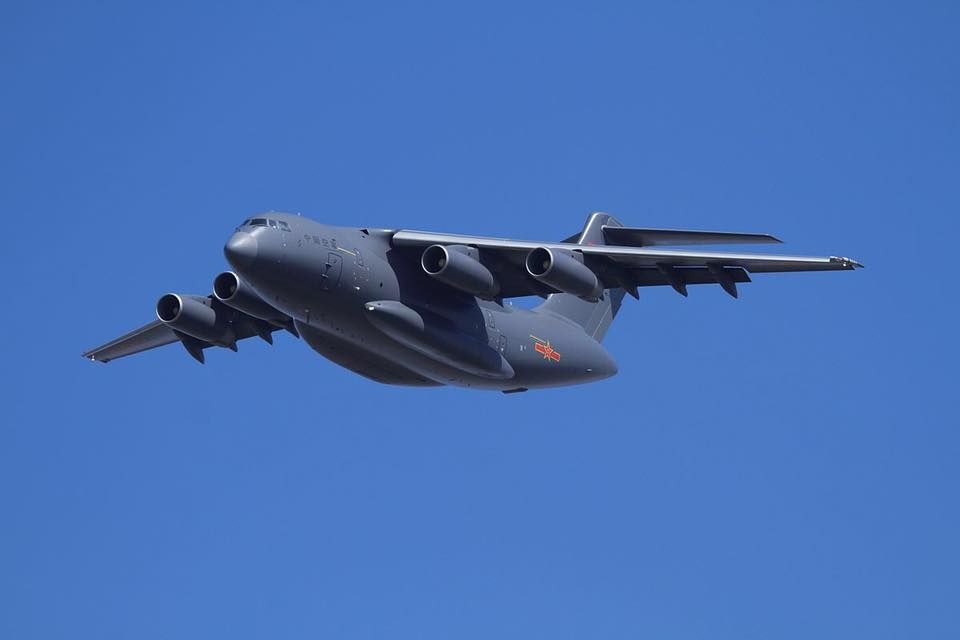
People's Liberation Army Air Force Y-20
China's People's Liberation Army (PLA) Air Force is confirmed to have inducted at least five of its new Xi'an Y-20 heavy transports into service. Having officially entered service in July 2016, the Y-20 is one of the most capable aircraft of its kind and represents a significant achievement under China's military modernisation program. Much as with many of China's most modern platforms, the aircraft relies on several technologies acquired from the former Soviet Union. These include Russian built D-30 turbofan engines and a wing design developed by Ukraine's Antonov Design Bureau. Antonov was also responsible for the design of part of the fuselage.
The PLA is currently equipped with Y-8 and Y-7 transports, lighter platforms both also based heavily on Antonov designs. The Y-20 is likely to serve and a stepping stone towards a fully indigenous design in future, and notably relies less on foreign technologies than its smaller predecessors. The D-30 engines are likely to be replaced by indigenous engines on future models of the Y-20 in the near future, while a fast growing military and civilian aviation industry mean that China may well have little need of support from Antonov for its design processes for its next transport.
The Y-20 has a high maximum takeoff weight of 200 tons, retains long range operational capabilities, and can effectively serve as a transport for supplies and personnel. Logistics were a key weakness of the PLA in its only major war, the Korean War waged in the 1950s, and the Air Force today still retains insufficient transport capabilities for the military's vast needs. As a result, the commissioning of the Y-20 serves as a significant step towards enhancing the PLA's operational capabilities.
