
United Arab Emirates Continues to Look Away From Western Arms - Acquires Advanced Chinese Attack Drones
Military Watch Magazine Editorial Staff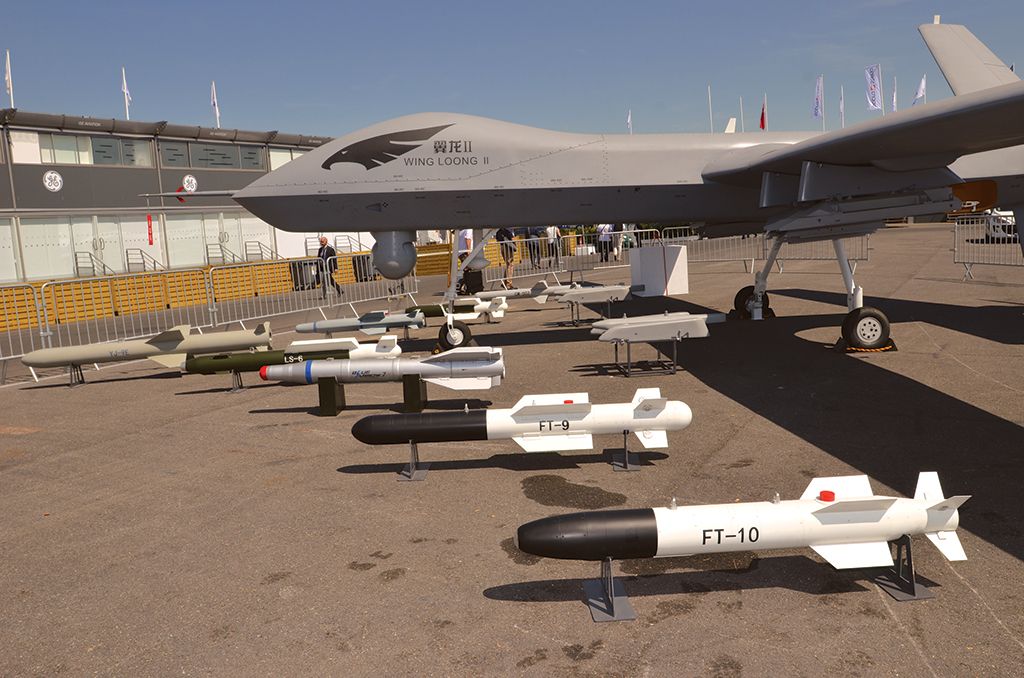
Wing Loong II Attack Drone
A longstanding client for Western arms, the United Arab Emirates has increasingly been diversifying its sources of arms in recent years as Western platforms have failed to provide for its defence needs. Perhaps the post prolific example of this is the country’s joint fifth generation fighter program with the Russian Federation to develop a heavy stealth platform for the UAE Air Force. With the United States banning exports of its F-22 Raptor, and reluctant to sell even its troubled F-35 light stealth fighter to the Gulf State, the country has turned to Russia to provide it with a fifth generation air superiority platform fulfilling a role analogous to that of the F-22. The country has also shown interest in the Russian Su-35 '4++’ generation air superiority fighter, which though it lacks stealth capabilities is otherwise among the most advanced in the world and in many fields exceeds even the F-22 in its capabilities. The UAE could potentially become the platform’s largest export client should orders currently under consideration go through. These Russian platforms would be the first non Western fighters the UAE has ever operated.
Recent reports and satellite imagery have confirmed that the UAE has recently acquired state of the art Chinese attack drones, the Wing Loog II. While China’s original Wing Loong, also known as the Petrodactyl, was available for export as an advanced reconnaissance drone from 2011, the new Wing Loong II variant is designed as an attack platform and carries up to twelve air to ground missiles. While the former platform is analogous in its role to the U.S. Reaper drone, the Wing Loong II is in many ways comparable to the renowned U.S. Predator drone in its capabilities. The drone carries a formidable payload of up to 400kg, and it can deploy three types of munitions. These munitions include Lan Jian (Blue Arrow) 7 laser guided air to ground missiles, TG100 guided bombs, and AR-1/HJ-10 anti-tank missiles. The Wing Loong II has a maximum speed of 370 kilometers per hour (Mach 0.3 - still subsonic) and a 1,500km combat radius (triple that of the F-16). The United Arab Emirates became the first export customer for the formidable new Chinese system, though other states including Saudi Arabia could potentially seek to import the same system in future should it prove effective in Emirati hands.
The Wing Loong II attack drones are set to prove an invaluable asset if deployed by the UAE to Yemen for combat operations. Indeed, with Yemen’s Ansurallah coalition forces having developed a capable air defence system and downed several highly sophisticated hostile aircraft including Saudi Arabian F-15 fighters, the UAE may well be able to minimise the risk to its pilots and costly F-16E fighters by relying on unmanned platforms to conduct airstrikes. Coming at a small fraction of the cost of both U.S. Predator drones and fighter aircraft, the Chinese platforms are set to prove highly cost effective. At approximately $1.5 million each compared to the Reaper’s $25 million, not to mention the F-15SA’s cost of over $100 million, the risk of losing a drone which is capable of performing a similar strike role is far lower. With both the UAE and Saudi Arabia facing growing economic difficulties, reliance on such efficient platforms as the Wing Loong II rather than highly costly Western fighter aircraft could well change they way they wage their air campaign in Yemen. With Saudi Arabia’s Air Force acting significantly more cautiously since suffering heavy losses in early January 2018, they could well look to such low cost and low risk platforms as the Wing Loong II to conduct future operations. The United States and other Western nations could well find themselves slowly squeezed out of one of their most critical arms markets, the Arab Gulf states, by more efficient and capable alternative weapons systems provided by China's burgeoning arms industry.
