
Singapore Announces Plans to Retire Increasingly Obsolete F-16 for More Modern Jets - A Look at What Could Replace Them
Military Watch Magazine Editorial Staff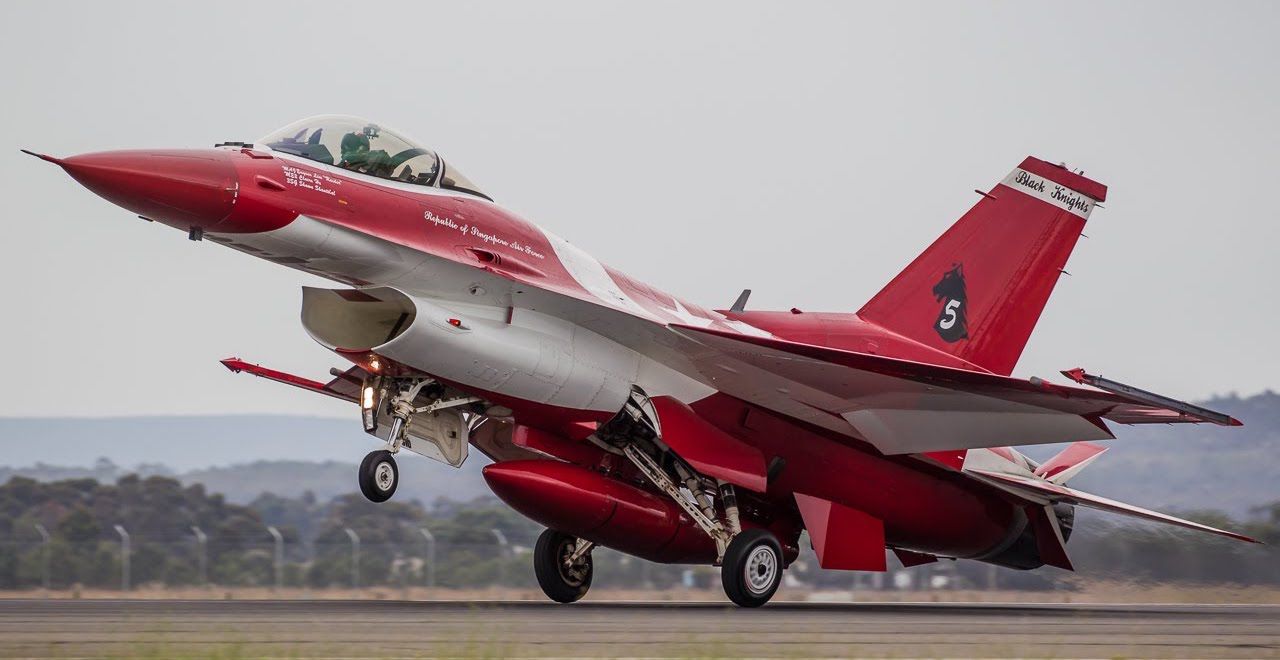
Singapore Air Force F-16 Light Fighter
As part of an extensive overhaul in its capabilities, the Singapore Air Force is set to retire its ageing fleet of approximately five dozen F-16C/D fighter jets in favour a more sophisticated platform. Having served for approximately 30 years, the aircraft’s maintenance requirements are rapidly increasingly as they near the end of there service lives. Singaporean Defence Minister Ng Eng Hen stated in regards to his country’s plans: “F-16s would face obsolescence beyond 2030.. To plan for a replacement is not as if you are going to buy a new car, you actually need a lead time of eight to 10 years. You need to know first of all what platform, what your needs are, how you are going to maintain. You also need to know how you are going to train your pilots, where you are going to train pilots, especially on such a small island.” The official noted that the military was set to make a decision within the coming months, leading to much speculation regarding the potential successor to the Fighting Falcon.
Singapore’s F-16s are fielded alongside the heavier and more capable F-15SG, with the latter designed for a strike role and also retaining limited air superiority capabilities while the former, with its shorter range and lower speed, payload and operational altitude, is relied on for a light support role. Singapore is likely to look for a light or medium weight fighter to replace the Fighting Falcon, rather than opting for a heavy air superiority platform for the mainstay of its capabilities as neighbouring Indonesia has. With Singapore’s defence planning heavily premised on matching the capabilities of its neighbours, Indonesia’s acquisition of cutting edge Russian Su-35 air superiority fighters is also likely to be taken into account.
One obvious candidate for the F-16’s replacement is the F-35A single engine stealth fighter. With Singapore having operated the Vietnam War era F-5E and fourth generation F-16, the F-35 represents the third platform in the series - a fifth generation light fighter built as a complement to America’s heavier F-22 Raptor air superiority fighters. With the F-22 prohibited from export, acquisition of the F-35 remains the only Western stealth fighter available for export - one highly compatible with Singapore’s existing capabilities and highly complementary to the F-15SG strike fighters. Singapore was one of just two Security Cooperative Participants in the F-35 program alongside Israel, and has show interest in the program from its early stages. Acquiring the platform would go along way towards cementing its already strong defence ties with the United States and the Western Bloc. Though the fighter lacks the speed, manoeuvrability, altitude and range of the advanced Su-30 and Su-35 jets fielded by its neighbours, the F-35 does retain an edge in its radar capabilities, and can operate with a lower radar signature and radar cross section than other fighters in South East Asia.
European twin engine medium weight fighters, the Eurofighter Typhoon and Rafale, are possibilities, though their extremely highly cost and mediocre performance relative to American made platforms puts them at a disadvantage. The aircraft are far too costly and high maintenance to replace the F-16, but equally too light and underwhelming the contend with the F-15 - perfect for European states which can only afford a single fighter class but far from ideal for Singapore which seeks to field two complementary fighter types. Another very interesting option raised by Singapore’s Defence Minister, which he referred to as ‘on the market,’ were Chinese made stealth fighters. While Singapore has long been a close client for Western arms, acquiring Chinese jets could be a way for the city state to cement its defence ties with the Pacific’s new major power - while operating both high end U.S. and Chinese jets would make the country’s air force quite unique. The J-31 medium weight stealth fighter will be able to deploy air to air missiles more capable than those of the F-15 or the F-35, with the cutting edge PL-15 and PL-12D far surpassing the low manoeuvrability variant of the AIM-120C used by the U.S. stealth fighter. The Chinese platform was designed to largely surpass the F-35 in combat, and will enter service in 2019. As a lighter complement to the J-20 air superiority fighter, the J-31 could well be made available for export at an early date - allowing Singapore to begin receiving the fighters in the late 2020s in line with its schedule. Though its exact specifications remain unknown, the J-31 would be a formidable addition to the country’s fleet. Whether Singapore can afford to proceed with such an acquisition, given the likely immense pressure of its Western backers not to acquire Chinese made arms and to instead look Westwards, remains to be seen, but largely for this reason and issues of compatibility acquisition of a Chinese jet remains unlikely.
