
Russia's Kilo Class 'Black Hole' Submarines - What Makes Them So Dangerous
Military Watch Magazine Editorial Staff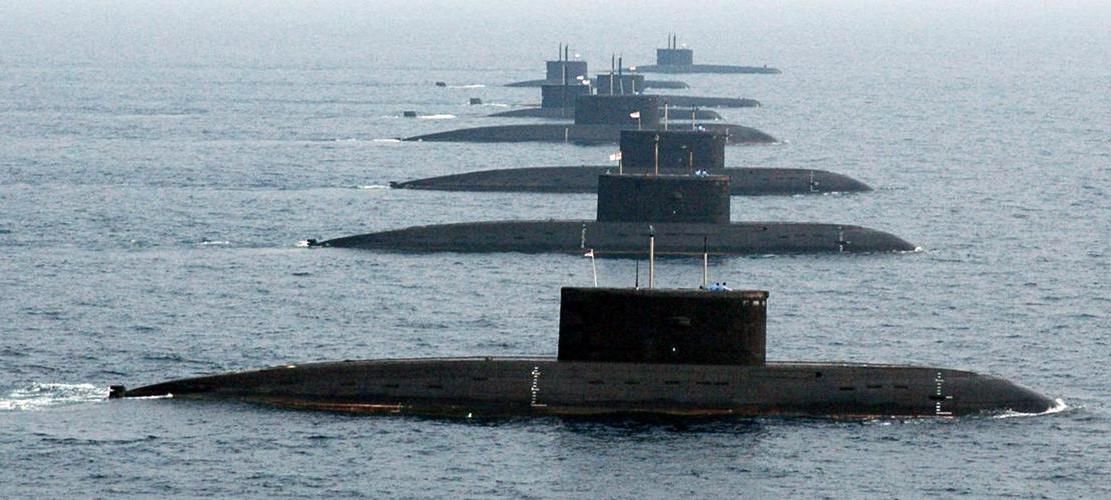
Kilo Class Diesel Submarines
Russia's military today maintains the world's fourth largest submarine fleet with 63 vessels in service - eclipsed only by those of North Korea (76), the United States (70) and China (68). While the U.S. fleet is comprised exclusively of nuclear powered vessels, Russia and the Soviet Union before it invested heavily in both nuclear and diesel powered vessels. The former submarine type retains the advantage of a longer endurance, able to remain at sea for months on end. This is ideal for carrying a nations' second strike nuclear weapons capability - Israel's Dolphin Class or Britain's Trident being prime examples. Diesel submarines on the other hand retain the asset of survivability, in that their systems are far quieter than those of their nuclear counterparts making them extremely difficult to detect. As indicated by the result of numerous wargames, examples being the U.S. Navy's engagement with Australian Collins Class and older vessels operated by Canada, Sweden and Japan among others, diesel vessels are without peer for engaging enemy surface vessels as well as enemy nuclear submarines - having proven lethal against both.
Russia today operates 28 Kilo Class diesel submarines, which serve complementary role to the country's long range nuclear powered fleet. For conflicts in Europe, the Middle East and Russia's Far East the platforms are more than adequate in range to defend Russian waters and those of its allies from hostile naval forces. Kilo Class submarines have been built continuously for well over three decades, and were first commissioned by the Soviet Navy in 1980. This serves as a testament to their potency, and 59 platforms remain in service in the navies of eight countries today. The warships are among the most capable warships of their kind ever developed, and are today operated by Poland, with a single vessel, India with nine, Iran with three, China with two and Romania with a single submarine. An enhanced variant of the Kilo Class, Improved Kilo, have significantly superior capabilities and feature improvements which make it extremely quiet and near impossible to detect when stationary. These modernized Kilo Class vessels are thus adequately named 'Black Hole' submarines by NATO - for their ability to effectively disappear from enemy sensors. Improved Kilo Class ships are operated by Vietnam with six ships, Algeria with four - and two more older vessels, and Russia. The Russian Navy operates 22 older Kilo variants, six Improved Kilo vessels, and has six more Improved Kilo boats on order for its Pacific fleet set to enter service by 2021. A number of other states including the Philippines have also shown interest in acquiring the highly cost effective warships - an asymmetric asset against rival powers at sea.
Improved Kilo Class submarines are equipped with potent Kalibr Class cruise missiles, advanced weapons capable of striking surface, land based and submarine targets at several times the speed of sound. The ships can also deploy advanced torpedoes and mines and can even be equipped with Strela-3 air defense systems, allowing them to strike aerial as well as naval and land targets. Perhaps the greatest asset of the Kilo Class however is its survivability, a result of its quietness which makes it extremely difficult to detect. The Kilo Class' hull is shaped like a drop of water, reducing its water resistance substantially. The propulsion plant is isolated on a rubber base so it does not touch the hull, an effective way to prevent vibrations from turning into noise. The ship's rubbery coating also helps to reduce noise. While it cannot stay submerged for months as longer ranged nuclear vessels do, the Kilo Class's air regeneration system can supply the crew with oxygen for up to 260 hours giving the ship respectable underwater endurance of almost two weeks.
Though Ukraine was responsible for the most shipbuilding in the USSR, Russia retained its submarine construction facilities after the collapse of the Soviet Union and has continued to manufacture these vessels while refining their design ever since. The Kilo Class submarines have been a major success, both in their capabilities and on world markets. They remain a significant threat to hostile naval forces, one of which the Western bloc has been highly weary. Serving in both the Chinese and Vietnamese navies, the Kilo Class are also a significant asset for these Asian powers as tensions in the South China Sea continue to escalate and both countries perceive significant threats from growing hostile naval deployments. In Iranian hands the warships could also prove invaluable assets when operating near the straits of Hormuz - one which could pose a major threat to the U.S. Navy's carrier strike groups when coordinating with other ship hunting assets. The Improved Kilo is set to be replaced by the even more capable Lada Class submarine, of which one currently serves in the Russian Navy. Reportedly even quieter and better armed than the Improved Kilo, the Lada is also likely to prove a widespread export success and further threaten the Western bloc's surface fleets in their escalating confrontation with Russia.
