
Rampage; The Israeli Air Force’s Deadly and Precise New Standoff Missiles and Why They Are Key to Enhancing its Strike Capabilities
Military Watch Magazine Editorial Staff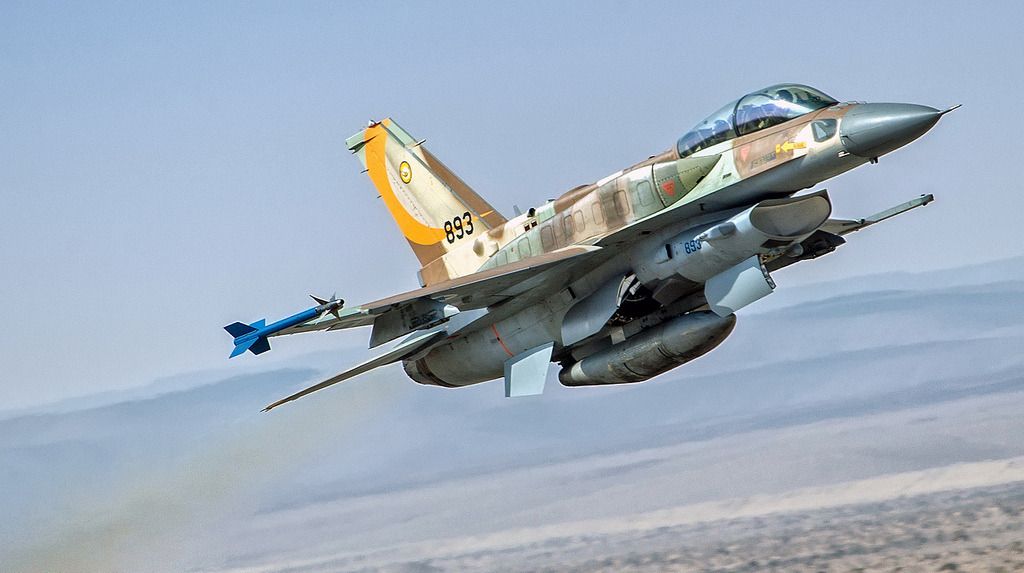
Israeli Air Force F-16 Light Fighter
Amid growing threats to Israeli air superiority and the ability of the country’s Air Force to launch strikes against hostile targets in the Middle East, the Israeli Defence Force (IDF) is set to commission a new air launched standoff missile to enhance the strike capabilities of its combat aircraft. The new weapon, dubbed ‘Rampage,’ can be deployed by the Israeli Air Force's elite F-15I Ra’am strike fighters and the lighter and shorter ranged F-16 and F-35 single engine multirole fighters. It is designed for precision strikes on enemy targets at long ranges, in most cases beyond retaliation range, which is ideal for countering advanced enemy air defence networks. The missile travels at supersonic speeds, making it both more difficult to intercept and more dangerous upon impact as it imparts substantial kinetic energy onto its target alongside the strength of its sizeable 570kg warhead.
The Rampage has been developed as a joint project by Israel Aerospace Industries (IAI) and Israel Military Industry (IMI) in response to the needs of the Israel Air Force to counter sophisticated anti access area denial (A2AD) missile networks. The platform's origins lie in IMI's Extended Range Artillery guided rocket (EXTRA), which has been extensively modified into an air launched platform. Amit Haimovich, director of marketing and business development for IAI’s Malam, stated regarding the purpose of the weapons system: “If you take the Middle East arena and areas protected by air-defense systems, the whole point of this missile is that it can hit targets within standoff ranges” - all without threatening the launching platform. With Israeli aircraft having increasingly resorted to striking Syrian targets from well beyond its borders, particularly given the vast investments made by Damascus in strengthening and modernising its air defence systems near its Western border, superior indigenous standoff weapons will come as a much valued asset to the Israeli Air Force. With a strike range of 145km, the missile can be delivered from beyond the range of almost all Syrian and Iranian Air Defence platforms.
Considering that a number of missile strikes have reportedly been blunted by Syrian air defences in recent months, with basic subsonic cruise missiles failing to bypass the country’s surface to air missile network, a new air launched missile designed specifically to improve survivability is invaluable. As Director Haimovich stated, due the Rampage’s combination of speed and specialised physical profile, “it can be detected, but it is very hard to intercept." According to Israeli media, the Rampage is set to be a weapon of choice for striking high value enemy targets such as command posts, airfields and maintenance depots. Its specialised capabilities give it the ability to do so even in a war’s early stages when enemy air defence networks remain strong. The Rampage does not have a straight ballistic trajectory, and is designed to be highly manoeuvrable to be able to better evade interception. With a GPS guided internal navigation system, it is capable of striking with high levels of precision in both day and nighttime conditions and is relatively resilient to electronic interference.
While the Rampage is set to pose a far greater challenge to Syria’s heavily upgraded Cold War era air defence systems than previous weapons platforms, how it will far against more sophisticated surface to air missile systems such as the S-300, S-400, BuK and Pantsir which are set to widely proliferate across the Middle East remains to be seen. At the very least, should the Rampage prove vulnerable to interception by these new Russian made surface to air missile systems, its long range will markedly increase the survivability of Israeli fighter jets by allowing them to conduct strikes from well beyond a country’s airspace. Even against state of the art surface to air missile platforms, the aircraft will be considerably more survivable at longer ranges where they have far more time to respond to and attempt to evade incoming missile attacks. With the Rampage set to enter mass production in 2019, and tensions between Israel and Iran fast escalating as the former threatens Iranian forces deployed in Syria and the latter threatens to restart enrichment of Uranium, a key facilitator of the development of nuclear weapons, the Israeli Air Force could well have much need for the new supersonic standoff missile in the near future.
