
Russia's Lethal New Artillery to be a Game Changer for Ground Forces; Army’s Modernisation Continues Apace
Military Watch Magazine Editorial Staff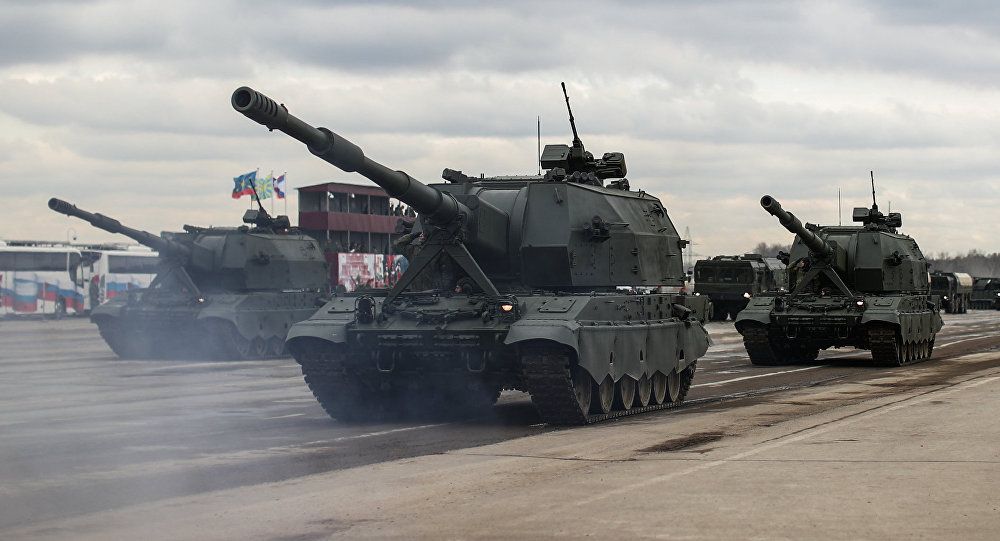
Koalitsiya-SV Artillery On Parade
One of several next generation weapons platforms developed for Russia’s ground forces, alongside the prolific T-14 and T-15 Armata platforms, the Nabrosok artillery system is also set to revolutionise the army’s ability to lay down fire against hostile positions. Commander in Chief of Russia’s Land Forces Col. Gen. Oleg Salyukov stated regarding the development of the new weapons platform: "For missile troops and artillery, the Nabrosok battalion level complex of artillery and mortar weapons with different versions of the chassis, including for the Arctic units, is being developed.” His comment came in response to a question regarding which new weapons could be expected to enter service in the country’s ground forces in the near future. The General further stated that development of the Koalitsiya-SV self propelled gun, a platform integrating a new Multiple Rounds Simultaneous Impact shooting mode for an unparalleled rate of fire, was almost complete.
The Koalitsiya-SV is set to retain the longest range of any artillery piece in the world at 61km, surpassing that of the current title holder the North Korean Koksan at 61km, and will also retain the highest rate of fire - surpassing the record set by South Korea’s K9 Thunder. The heavily automated 152mm self propelled gun fire up to up to 20 rounds per minute - far surpassing its U.S. analogue the M109 Paladin which can fire just 6 rounds per minute. Considerable advantages in range and firing rate will give Russia’s artillery forces a considerable edge over potential adversaries, allowing Koalitsiya-SV batteries to strike hostile positions from well beyond retaliation range. Western made pieces such as the Paladin for example, restricted to 29km, have a range 58% shorter than the Koalitsiya-SV - and even the South Korean K9, overall considered the most sophisticated self propelled artillery piece in the world, is restricted to a range of 56km when using specialised extended range shells. High levels of automation, with fully automatic ammunition handling, loading, targeting and charge selection systems further allow the Koalitsiya-SV to operate with just a two or three man crew - where the American Paladin requires six and the South Korean K9 requires 5. The new weapons system is thus set to serve as a major force multiplier for Russia’s artillery forces.
General Salyukov added that Russia’s ground forces would, alongside new artillery, are also imminently set to receive new T-14 Armata tanks, Kurganets-25 modular platforms, and Bumerang amphibious armoured personnel carriers. While the T-14 has been held back from mass production, a result of both its high cost and Russia’s faith in existing far less costly platforms such as the T-72B3 to retain a considerable advantage when engaging the latest Western armour, other next generation systems are likely to enter service in large numbers at an earlier date. A modernisation of Russia’s artillery forces with next generation weapons systems is thus likely to occur far sooner than modernisation of its tank forces, with the Armata entering service in limited numbers to familiarise the ground forces with its operation and equip some elite units.
