U.S. Drones Prove Vulnerable to Russian Electronic Attacks Over Syria, Crimea
Military Watch Magazine Editorial Staff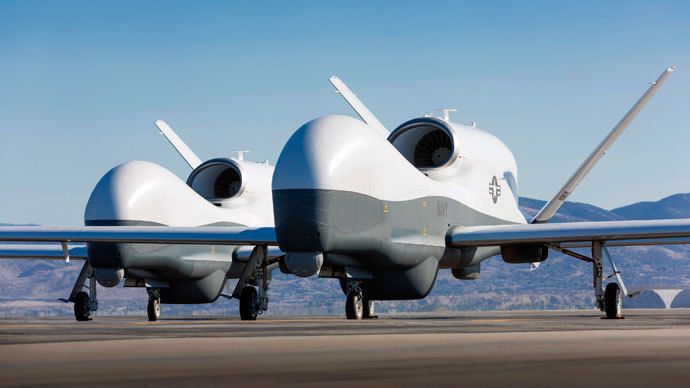
Northrop Grumman MQ-4C Triton UAVs
Reuters / Chad Slattery
U.S military officials have reported that Russia’s armed forces have for weeks used jammers to disrupt the operations of smaller American drones over Syrian airspace. With the U.S. threatening military action against the Syrian government, in response to allegations of chemical weapons attacks on Islamist held areas of Eastern Ghouta, Russia began jamming the GPS systems of a number of U.S. unmanned aerial vehicles (UAVs) operating in the area - while also deploying more advanced electronic warfare equipment to its military facilities. While the U.S. military has increased its reliance on UAVs for a number of operations from surveillance to airstrikes, particularly under the Obama administration from 2009, these weapons systems remain highly vulnerable to basic scrambling of reception which is a relatively uncomplicated and highly effecting way of neutralising the threat posed by such remote platforms. The U.S. Department of Defence refused to comment on whether any crashes had occurred as a result of Russian jamming efforts. Unlike the United States, Russia’s armed forces have not made extensive use of drone technology for its own military operations - but has invested heavily in technologies to counter these platforms.
Dr. Todd Humphreys, the director of the Radionavigation Laboratory at the University of Texas at Austin and expert on GPS jamming, stated regarding the vulnerability of military drones to electronic warfare: "GPS receivers in most drones can be fairly easily jammed… At the very least it could cause some serious confusion" for operators, and could potentially lead to a malfunction or crash. The expert noted that Russian jammers had previously been active in disrupting the operations of Western drones operating over Ukraine and Crimea in 2014 in the aftermath of Russia’s annexation of the peninsula. Russian jammers "had a pretty significant impact" and grounded NATO's drone fleet for days, preventing them from gathering intelligence from the air during that critical period.
Dr. Humphreys stated regarding the seriousness of the electronic attacks on U.S. drones: "They are a little less hostile looking than a kinetic bullet but sometimes the effect can be just as damaging. It's like shooting at them with radio waves instead of bullets." Russian jammers have proven highly effective against encrypted signals and anti jamming receivers supposedly immune to such interference. The drones targeted so far have been smaller surveillance aircraft, though should tensions escalate Russia could potentially aim to target the larger Predator and Reaper drones that often operate in combat environments and can be heavily armed for strike missions. The potential consequences of electronic warfare against advanced advanced U.S. UAVs were made clear in 2011 when Iran, a state with far less capable electronic warfare systems than Russia, managed to remotely commandeer a U.S. RQ-170 stealth drone operating over the country's airspace and land it safely - after which Iran's military conducted an extensive study of the platform's technologies and reverse engineered a number of them for their own drone and stealth fighter programs. With Russia's far more sophisticated electronic warfare systems deployed to Syria, and the vast majority of U.S. drones deployed to the country lacking the advanced radar evading capabilities and survivability of the RQ-170, the potential consequences of an all out Russian attack on U.S. UAVs could be catastrophic for the U.S. military and lead to further losses of both assets and sensitive technologies. With the United States' new F-35 joint strike fighters similarly heavily reliant on complex electronics and intercommunication, they could also prove highly vulnerable to such jamming and electronic warfare in the event of conflict.