
Intimidation or Reassurance for Pyongyang? F-22 Raptors Deployed to Demonstrate Force in Korea Malfunction Amid a Series of Failures Among US Fifth Generation Platforms
Military Watch Magazine Editorial Staff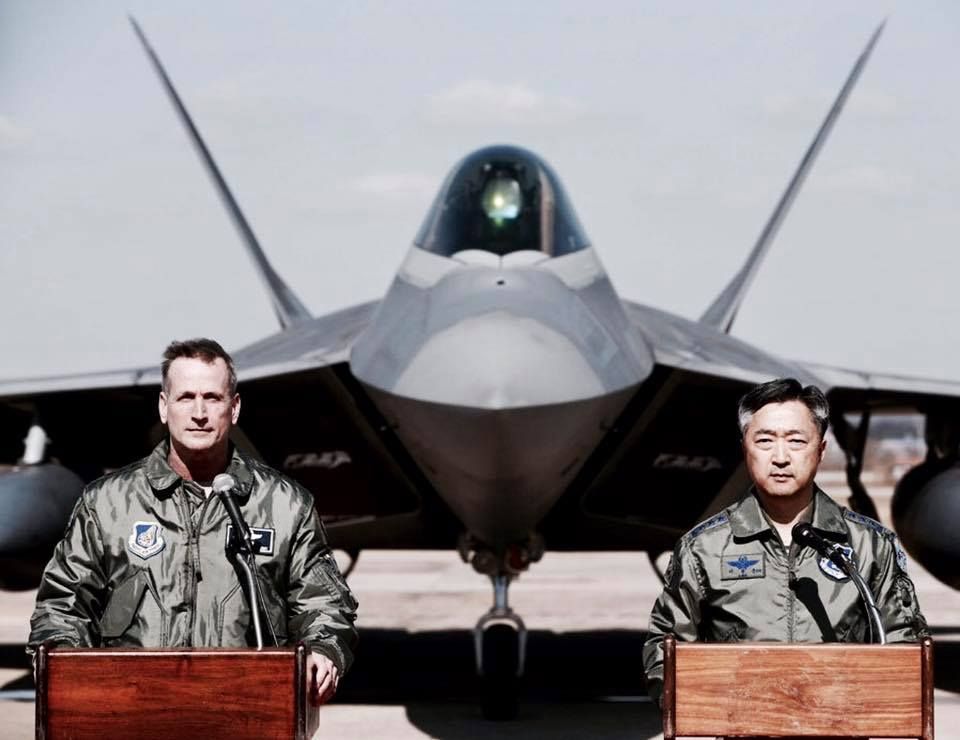
F-22 Raptor in South Korea
The F-22 Raptor is by far the most capable air superiority platform in U.S. service - one of only two fifth generation air superiority fighters in the world. The early termination of the program left the Air Force with just 25% of the fighters it initially required, while the Navy was left without a single carrier based Raptor. As a result the fighter is extremely thinly spread across US military facilities worldwide, with deployments reduced to just six fighters each. Amid escalating tensions with North Korea, the United States has made its largest ever deployment of F-22 fighters to the Korean Peninsula - sending six of its F-22s. The fighters were meant to intimidate Pyongyang during large scale drills, the elite of a fleet of over 230 participating aircraft. The Raptors' performance however was hardly impressive or intimidating, and as is commonplace with U.S. fifth generation platforms serious technical malfunctions left fighters costing well over $200 million completely inoperable.
Though the F-22 is considered by far the most reliable of the United States' two fifth generation fighters, it is not without its defects. According to the U.S. military magazine Stars and Stripes, an F-22 Raptor experienced a technical malfunction on the first day of the drills after landing. The fighter became immobilized and had to be towed off its runway to the hangar. The Raptor couldn't itself move from the middle of the runway. News of the failure of the F-22 comes amid numerous reports of severe underperformance among U.S. fifth generation fighters. From an F-35 which lost a panel mid air days before the Raptor's incident to months of software and design flaws grounding the F-35, the United States' lighter and less costly fighter has if anything exceeded the Raptor in its shortcomings, malfunctions and overcomplexity. The F-22 is however the most high maintenance fighter in the U.S. military, and in the world, and costs well over $70,000 dollars per hour to operate due to the hours of costly maintenance and parts replacements it requires. Currently untested in combat, and with an extremely low sortie rate and deep cuts to its pilot training programs, the deployment of just six Raptors is hardly a major threat to Pyongyang. The fighters will, much like the F-35, be unlikely to fly more than a single sortie weekly and this could well give Pyongyang, with reliance on extremely low maintenance platforms, a critical advantage. Indeed, the U.S. attempt to intimidate North Korea by deploying the F-22 may well have backfired reassuring Pyongyang of the poor state of readiness the U.S. Air Force's as a result of both budget cuts and an over reliance on overly complex and often unreliable technology.
