
Putin Confirms New Oreshink Hypersonic Missile Will Enter Service Within 13 Days: Targets Across Europe Within Reach
Military Watch Magazine Editorial Staff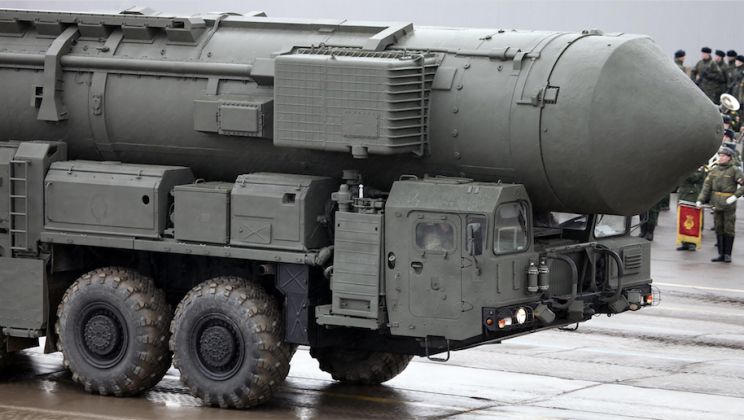
Russian Yars Ballistic Missile
Russian President Vladimir Putin on December 17 announced at a meeting of the Defence Ministry board that the Oreshnik intermediate range ballistic system will be placed on combat duty by the end of 2025. Developed as Russia’s first post-Soviet intermediate range ballistic missile type, the Oreshnik was confirmed in June to have entered serial production, and is estimated to have a 4000 kilometre range while carrying multiple independently re-targetable warheads mounted on hypersonic reentry vehicles. These vehicles can manoeuvre and approach targets from unexpected directions, which combined with their sheer speeds seriously limits the ability of traditional air defence systems, such as Germany’s recently procured Arrow 3 system, to intercept them.

The Oreshnik’s development has been considered a potential game changer for the balance of power in Europe, as it holds military, strategic and political targets across the continent with reach of high precision strikes that are effectively impossible to intercept. A pre-production variant of the missile was first fired in combat on November 21 against Ukrainian targets, at which time the program’s existence was announced to the world. The Oreshnik’s capabilities have raised significant concerns across much of the Western world, with Russian Ambassador to the United Kingdom Andrey Kelin claiming shortly after its first combat launch that it had had a significant impact on British policy toward Moscow, forcing London to take a more cautious approach towards supporting Ukrainian deep strikes into Russia.

Deployments of the new ballistic missile system on the territory of Russia’s sole European ally Belarus are expected to be prioritised, with Secretary of the Russian Security Council Alexander Volfovich confirming on May 29 that such deployments would begin before the end of the year. The missiles are expected to be mounted on the Belarusian MZKT-79291 chassis with a 12 wheel configuration. It is expected that conventionally armed variants will exported to equip the Belarusian Armed Forces, while nuclear armed variants will fall under Belarusian control during wartime as part of the Russia and Belarus’ nuclear sharing agreement.
Analysts have widely speculated that Russian interest in the Oreshnik has been further increased after the first large scale combat test of long range tactical ballistic missiles in June saw the Iranian arsenal play a central role in determining the outcome of its conflict with Israel. This heavily compensated for Israeli air power advantages. If procured on a large scale, the Oreshnik may similarly provide the capability to inflict unacceptable costs on European capitals without crossing the nuclear threshold, compensating for Russian disadvantages in multiple parts of its conventional forces and particularly its air power.
