
The Xian JH-7 Strike Fighter; A Look at China’s First Fourth Generation Combat Aircraft
Military Watch Magazine Editorial Staff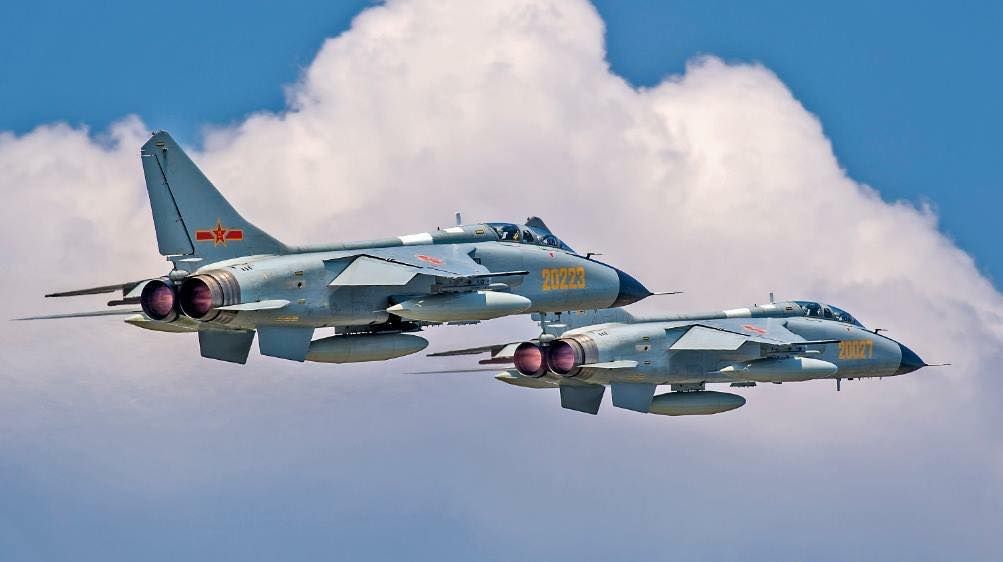
Chinese JH-7 Strike Fighters
The Xian JH-7 was the first fourth generation fighter to enter service with China’s People’s Liberation Army (PLA) Air Force, with the first units delivered in 1992. While China’s military had long relied on upgraded variants of older combat aircraft such as the J-7M fighter and J-8III Interceptor, it lacked a strike fighter capable of fulfilling the Air Force’s needs and had formerly fielded only heavy long range bombers such as the Harbin H-5 or low altitude attack aircraft such as the Harbin Q-5 capable of fulfilling a dedicated air to ground role. In the mid 1970s the Air Force thus sought to commission a modern strike fighter into service, and submitted a request to the country’s Ministry of Aviation Industry. The program was authorised only in 1983, when the country’s economic upturn meant additional funds were available for such high end military programs. The JH-7 was the most ambitious fighter program the country had developed until that time.
The JH-7 entered service shortly before the introduction of the Russian Su-27 air superiority fighter into Chinese service, which alongside its more advanced variants such as the Su-30 and domestically manufactured J-11B provided the PLA Air Force with world leading air to air combat capabilities - ensuring that the JH-7 would be conserved exclusively for a strike role. With the disintegration of the Soviet Union and Beijing’s subsequent reconciliation with Moscow removing any potential for conflict what had long been the PLA’s primary potential adversary, the Pacific theatre and the United States military became China’s primary security concern - particularly considering the sharp deterioration in relations with the Western bloc from 1989. The JH-7’s long range and high payload incidentally made it an ideal anti shipping strike platform, and the fighter entered service in roughly equal numbers in both the Navy and the Air Force as a result of its significant potential for maritime interdiction.
By the mid 1990s the PLA had modernised its capabilities significantly from the time the JH-7 was first conceived, and the platform required significant capability enhancements to keep pace with the rapid and widespread modernisation taking place across the military. The JH-7A advanced variant was thus designed with a number of new features which significantly enhanced the platform’s combat performance. The fighter has a lighter but more robust airframe, increasing its maximum payload to 9000kg. Helmet mounted sights compatible with the JH-7’s airborne sensors and its munitions were also installed, alongside a number of liquid crystal multi function displays. The platform’s avionics upgrades also include the installation of a state of the art BM/KJ-8605 nose jammer, Type 271 radar altimeter and a JL-10A pulse doppler radar to replace older and less capable systems. Most notably perhaps, the fighter gained the ability to deploy both satellite and laser guided precision air to surface munitions, which combined with new and more advanced radar systems made the aircraft far more capable in a beyond visual range strike or interdiction role. The JH-7A also received a significant increase in firepower, with more advanced missiles further enhancing the platform's range in anti ship operations. Air launched variants of its YJ-82 long range anti ship missiles seeing their strike range increase to well over 300km. The new platform also saw an increase in its external hard points from four to six. The strike fighter’s new lighter airframe meant it could carry four YJ-82 missiles rather than the two its predecessor had been restricted to.
Approximately 250 JH-7 fighters are currently in service, and the fighter continues to be modernised with new variants making greater use of composite materials and integrating more advanced fly by wires, in flight refuelling systems and superior mission computers. New engines have also been installed on more recent variants to replace the dated Xian WS-9 turbofans. While the JH-7 far eclipses the capabilities of strike fighters which were in service when the program begun such as the U.S. F-111 Aardvark and Soviet Su-24 Fencer, it is hardly the most advanced strike fighter in service today particularly when compared to more modern platforms such as the Russian Su-34 or U.S. F-15E. Its development nevertheless represented a significant landmark for Chinese military aviation and the modernisation program allowed the PLA Air Force to pioneer a number of new technologies, facilitating the country’s formidable military industrial base it retains until today.
The JH-7 today retains only limited defensive air to air combat capabilities, deploying the relatively short ranged PL-5, PL-8 and PL-9 and lacking advanced long range anti aircraft capabilities. The use of advanced laser and satellite guided bombs and anti radiation, air to air and air to ship missiles capable of striking ground and naval targets at extreme ranges however is a considerable asset, and as the PLA develops more capable weapons systems they will continue to be installed on the JH-7. While formidable, the JH-7 has largely been surpassed in its strike capabilities by the more advanced J-16 which entered service in 2013. Based on the J-11 airframe, the platform is one of the most advanced strike fighter in service - possible the most capable anywhere in the world, and makes use of a number of technologies developed for the JH-7. The J-16 retains a number of advantages including deploying more advanced air to air munitions for beyond visual range engagements, far superior manoeuvrability and a higher speed, range and maximum altitude among a number of other attributes. With the PLA Air Force having demonstrated its confidence in the new strike platform in early 2018, displaying it alongside the new J-20 stealth fighter, the J-16 is set to enter service in ever greater numbers in future. The military’s need for the JH-7 may well decrease as a result, and the strike platform has reportedly since been converted into an advanced experimental electronic warfare platform comparable to the U.S. EA-18G Growler.
Ultimately the JH-7’s airframe is set to see a number of uses, and the fighter will remain a key part of the PLA’s strike capabilities for years to come. With the J-16 not having been equipped for a specialised anti ship strike role, notably lacking the JH-7's advanced YJ-82 anti ship missiles, the JH-7 could well see continued service in a dedicated maritime interdiction role where the J-16 is used for a conventional strike role. This would closely reflect the military's similar repurposing of the H-6 bomber for maritime interdiction in light of the imminent induction of the more advanced H-20 bomber. With China’s armed forces having repeatedly demonstrated an ability to keep older combat aircraft viable for decades longer through life extending modernisations, the JH-7 is set to have a long service life with the PLA and with the Navy in particular - which may well be only just beginning. As tensions grow between Beijing and the Western bloc in the South and East China seas and the United States its European partners deploy ever larger Naval fleets near China's territory, the JH-7's importance to the PLA may well be greater than ever before.
