
The Queen Elizabeth Class Primarily an Aircraft or Helicopter Carrier? British Carriers' Extreme Reliance on Rotary Wing Aircraft
Military Watch Magazine Editorial Staff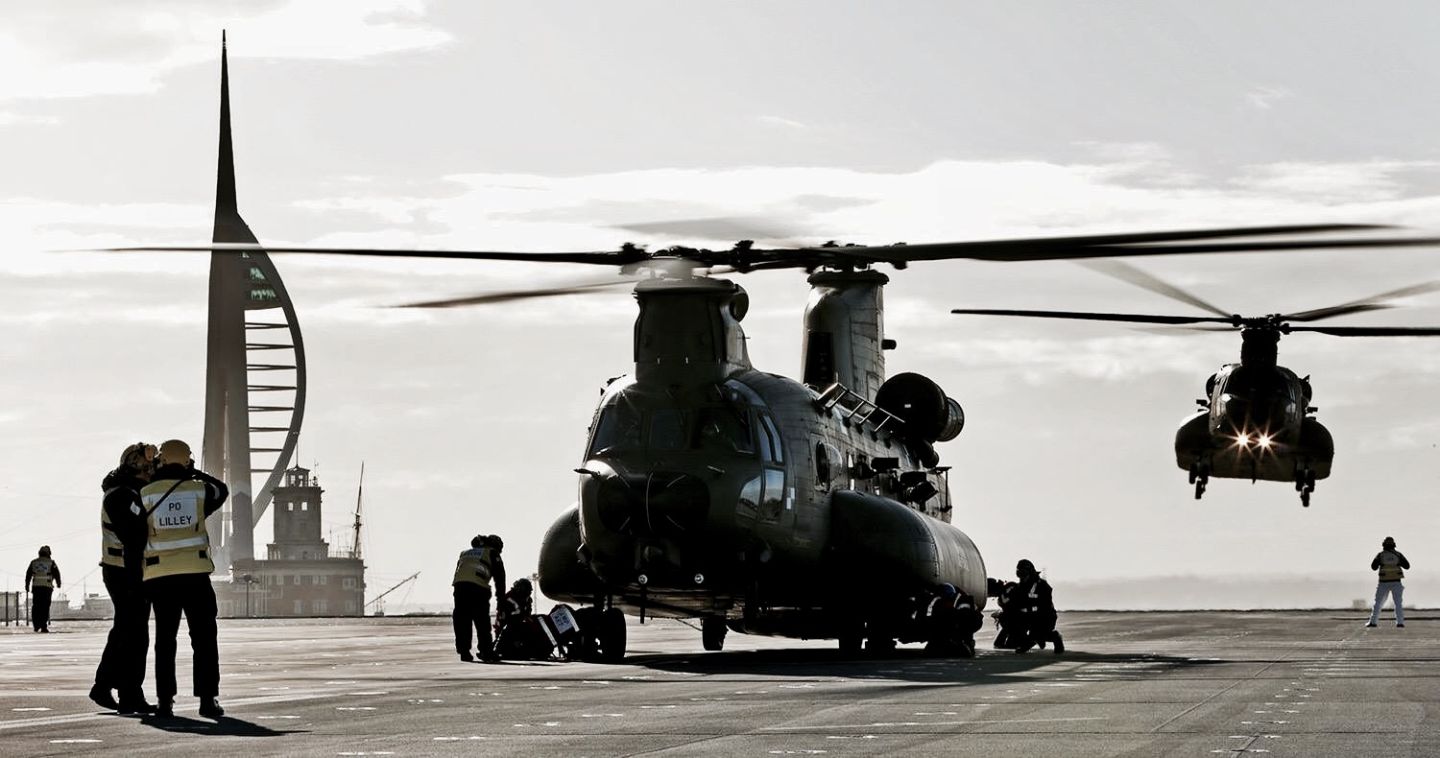
Chinook Helicopters Onboard the HMS Queen Elizabeth
Commissioned in 2017, the British Royal Navy's largest ever warship the aircraft carrier HMS Queen Elizabeth has continued to make progress towards obtaining full operational capability. On 2 February 2018 the carrier left port to undergo the first phases of operational training, a process set to take six weeks. The carrier has deployed its first ever air squadron, and the aircraft operating from its deck are set to take part in operational training.
The Queen Elizabeth Class carriers are among the heaviest in the world, displacing 65,000 tons, and are expected to deploy 40 aircraft each. Despite their size however, the carriers' fighter contingents more closely resemble those of small helicopter carriers rather than heavy platforms such as the U.S. Navy's Gerald Ford Class or French Charles De Gaulle. The British platforms notably lack both catapults and arresting gear, meaning much like the U.S. Wasp Class assault ships and other lighter platforms they can only deploy helicopters and short takeoff vertical landing (STOVL) capable fighters. With the only STOVL fighter currently in production being the F-35B fighter, the British carriers are forced to rely heavily on helicopters for all other roles from airborne early warning and control systems (AWACS) to ferrying troops and transporting supplies. The importance of helicopters to the Queen Elizabeth Class therefore cannot be understated.
The aircraft squadron deployed to the Queen Elizabeth carrier in February was comprised entirely of helicopters, known as the Royal Navy’s Carrier Strike regeneration squadron. The carrier is set to deploy four helicopter variants including the Chinook, Apache, Merlin, Wildcat and Merlin Crowsnest. With the carriers unable to deploy an equivalent to the U.S. Grumman C-2 Greyhound carrier onboard delivery aircraft, the heavy Chinook platforms are critical to sustaining longer carrier operations at sea by providing additional supplies. Their far lower range relative to the Grumman however will seriously restrict the length of blue water operations the carrier can undertake. The Merlin Crowsnest will also fill in for a role more effectively carried out by fixed wing aircraft onboard U.S., French and Chinese carriers, that of an airborne radar system. While the three aforementioned carrier powers can all deploy AWACS aircraft to coordinate the attack, either the E-2 Hawkeye or the KJ-600, the Queen Elizabeth Class carriers are forced to rely on a helicopter based airborne early warning (AEW) carrier systems which lacks the range or coordination capabilities of AWACS. Ultimately helicopters will be relied on to carry out almost all roles from the Queen Elizabeth Class' deck, from ferrying troops to search and rescue, and training for carrier operations using rotary wing aircraft which has now begun is if anything more essential than preparation of the F-35B platforms. Fighters will only be used for combat operations which may never occur whereas the carrier will rely on helicopters for all day to day operations and for most deployment scenarios such as disaster relief and search and rescue where the country's fixed wing fighters will be of little use.
