
The Vulnerability of the U.S. Military Pacific Command's Facilities to Missile Attacks and How this Serves North Korea's Deterrence Capabilities
Military Watch Magazine Editorial Staff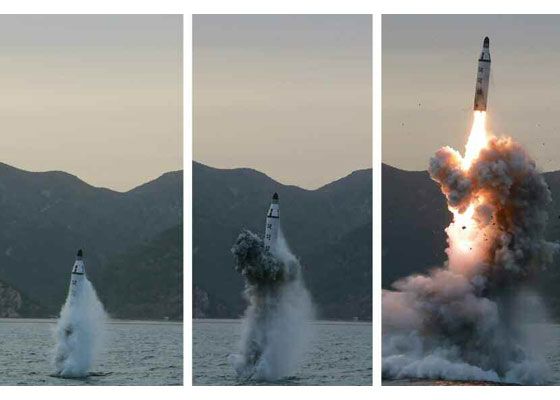
Pukkuksong-2 Submarine Launches Ballistic Missile
While the U.S. Pacific State of Hawaii houses critical Navy and Air Force infrastructure, as well as 50,000 US military personnel, its true strategic value as a target is as the base and centre of the U.S. Pacific Command. From this command centre military operations across 52% of the Earth's surface - covering most of the world's population and five of the seven US collective defence treaties - are run. The area under the U.S. Pacific Command includes most of the United States' most important strategic areas including all of South and Southeast Asia from Pakistan to Papua, as well as Oceania, Antarctica, Russia's Far Eastern territorial waters, China, Mongolia, Korea and Japan. It is by far the most critical command centre outside the U.S. mainland, likely the most critical in the world after the Pentagon, and its value as a target is immeasurable. Should the Pacific command be lost the U.S. military's operations across much of the world would be in disarray and its network of global military installations built up since 1950 allowing it to operate across the world would for be seriously undermined possibly beyond recovery.
Aside from targets on U.S. territories such as Hawaii and Guam, the United States maintains military facilities in Japan, South Korea and Okinawa, among several other East Asian nations. Facilities in Japan and Korea alone between them house over 70,000 US personnel, and these also remain vulnerable to short and medium range missile attacks - and in the case of several bases in Korea even to artillery. Considering that the United States' Patriot missile systems deployed to protect its bases has when fielded against Iraq intercepted well under 5% of its relatively primitive SCUD B missiles, and that RAND corporation, in their study of the vulnerability of U.S. Pacific military facilities assumed a missile interception success rate of under 25%, the Pacific Command's facilities across the Pacific would be lucrative targets for Korean missile strikes.
With numerous modern high maintenance aircraft such as the F-22 and F-35 costing well over $100 million, or the B-2 costing over $2 billion, having been deployed to the Pacific - all of which have extremely high maintenance requirements meaning that they spend well over 98% of the time grounded - these too will present lucrative targets. Ultimately with these bases in reach of its missile arsenal, North Korea has the leverage needed to deter U.S. military action against it for the time being. It will meanwhile continue the development of the Hwasong 15 three stage missile with 12,000km range, as opposed to Hwasong 14's 10,000km range, putting targets near the U.S. East coast such as Washington and New York within range of its nuclear strikes.
Other programs such as the new Gorae Class nuclear submarines and the Pukuksong 3 submarine launched ballistic missile currently under development will give North Korea a more reliable nuclear force by providing a secondary deterrent - making U.S. attacks near impossible. With the United States refocusing its military forces towards the Asia-Pacific region it cannot afford the loss of its most essential military facilities and tens of thousands of its personnel - not to mention being made to appear vulnerable in a region where its provision of security is the key pretext for its military presence. If America's military appears unable to defend itself and its facilities from North Korea - its regional military partners will seriously question how it could possibly defend them against more capable potential adversaries such as China. Considering the vulnerability of military facilities such as those on Guam to missile attacks, as attested to by the U.S. military's own analysts, North Korean retaliation against American forces in the Pacific could well undermine the longstanding American regional dominance held since the 1940s by both destroying the credibility of its protection and eliminating the military infrastructure, personnel and equipment essential to its power projection.
